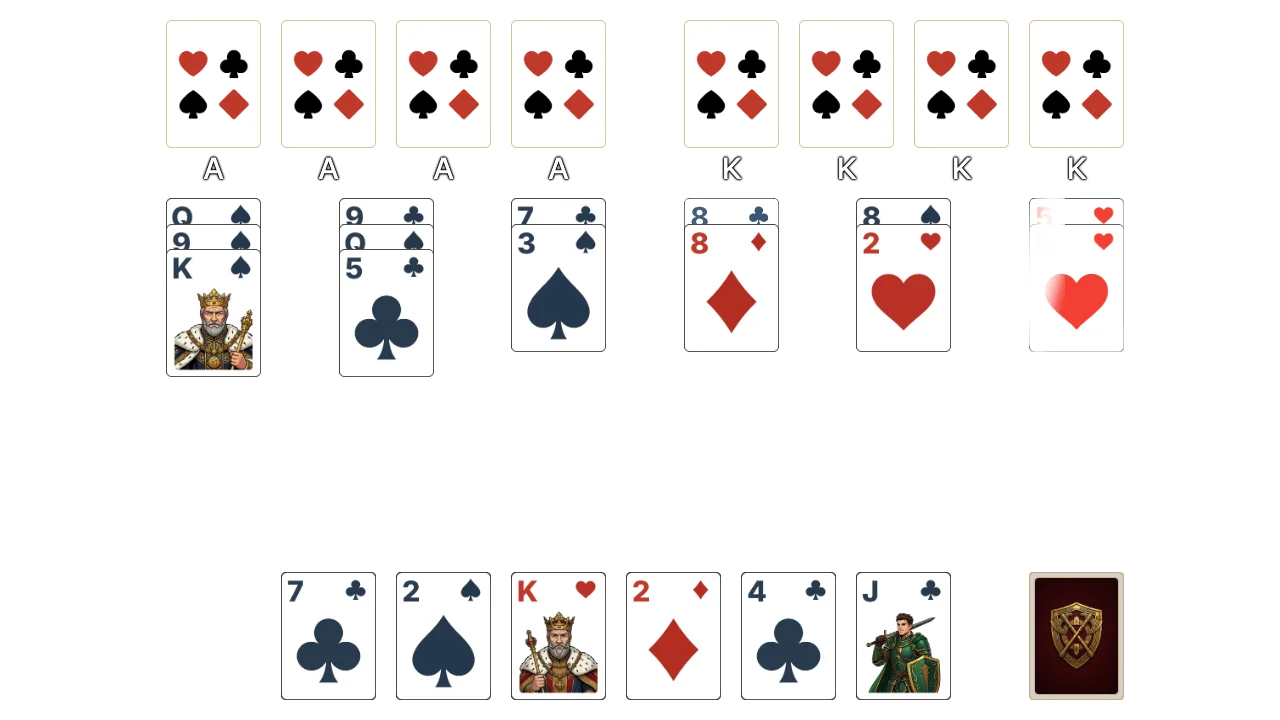
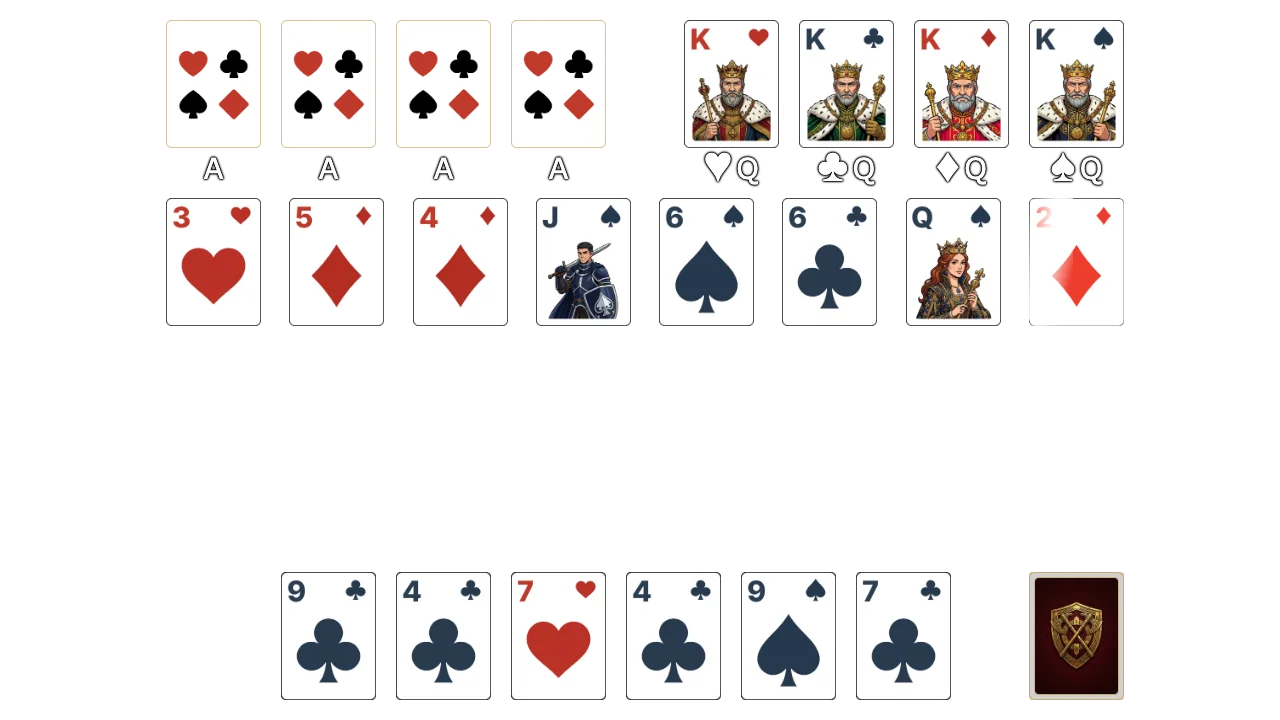
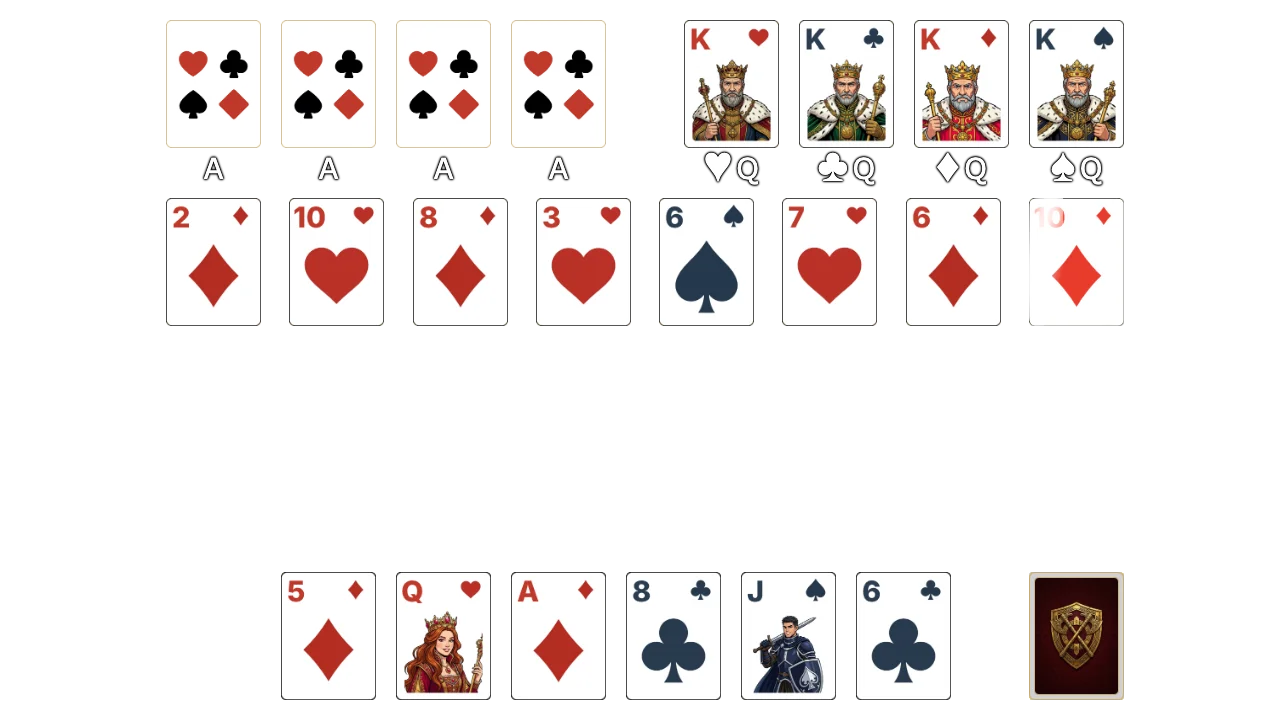
Goal of the game
Move all 104 cards (two complete decks) onto the eight foundations by suit. Four foundations build up from Ace to King; four build down from King to Ace. The game is won when each suit's up-built and down-built foundations have absorbed all cards — typically meeting around the 7-8 boundary of every suit.
Setup
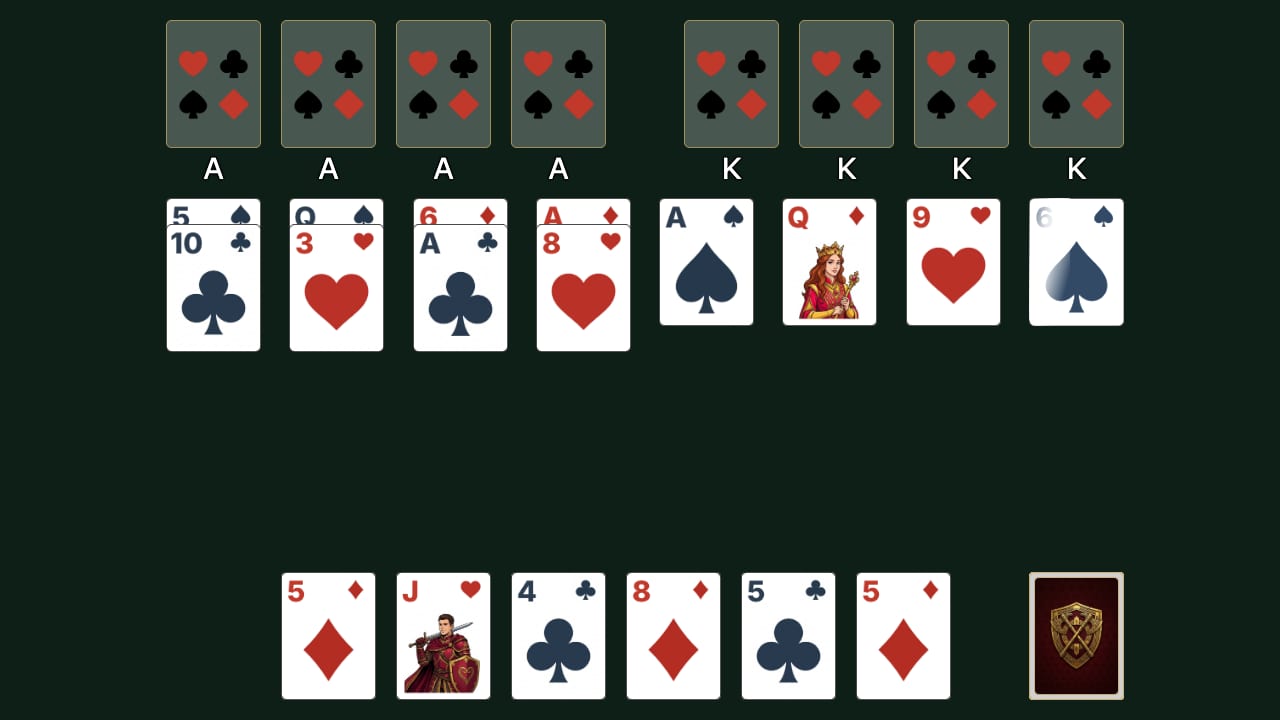
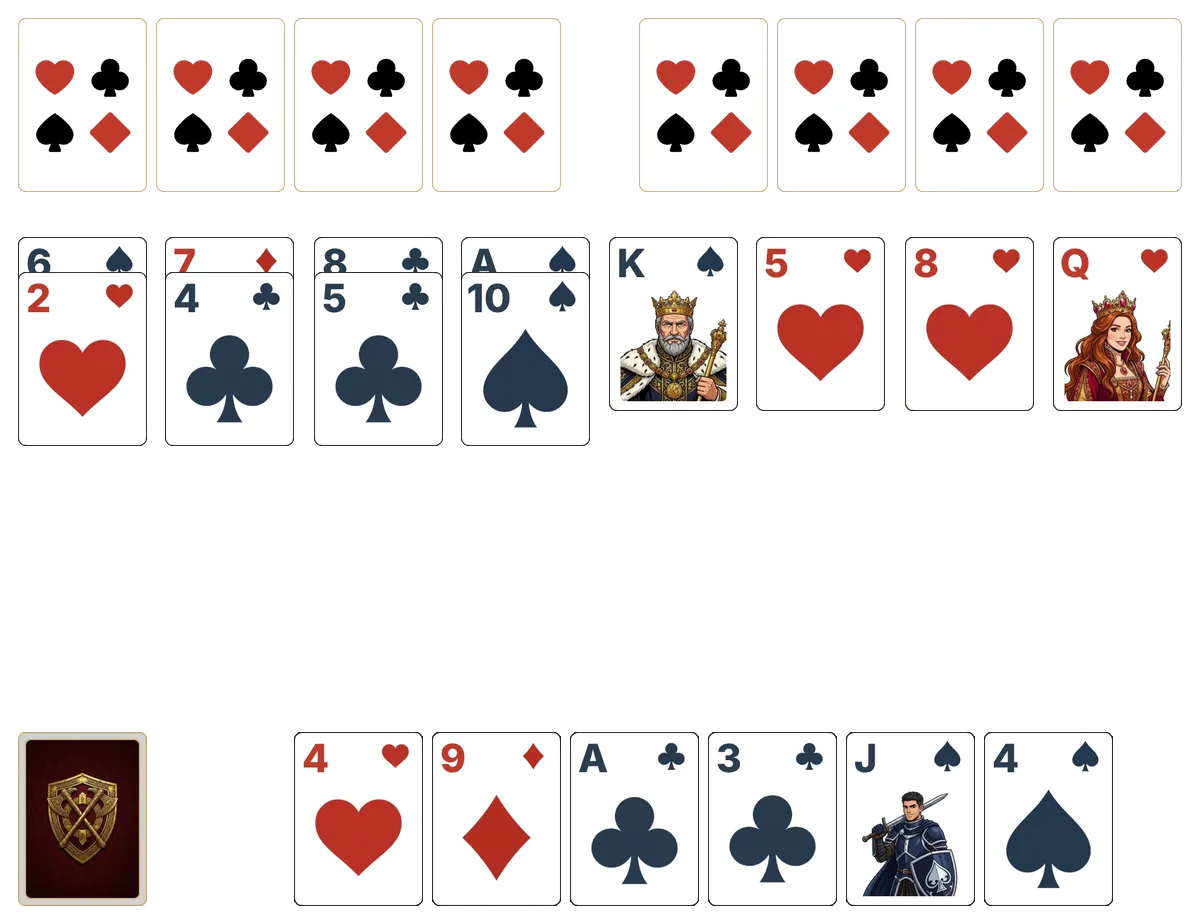
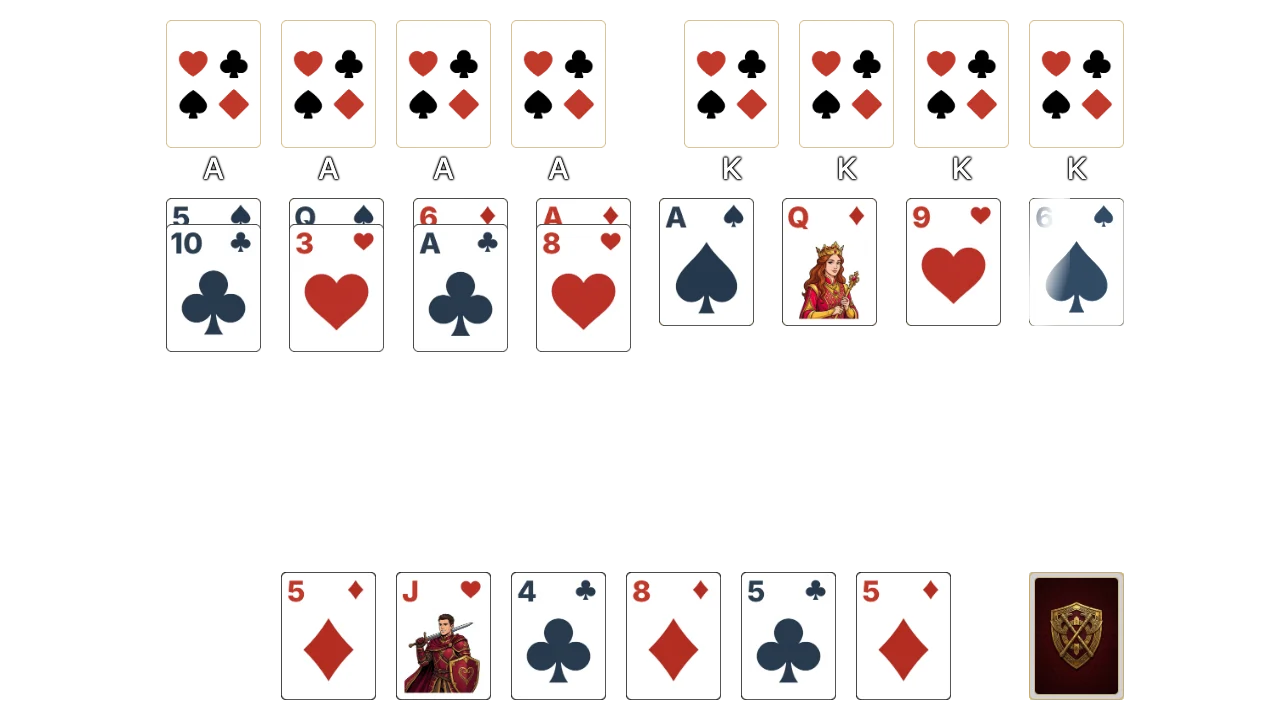
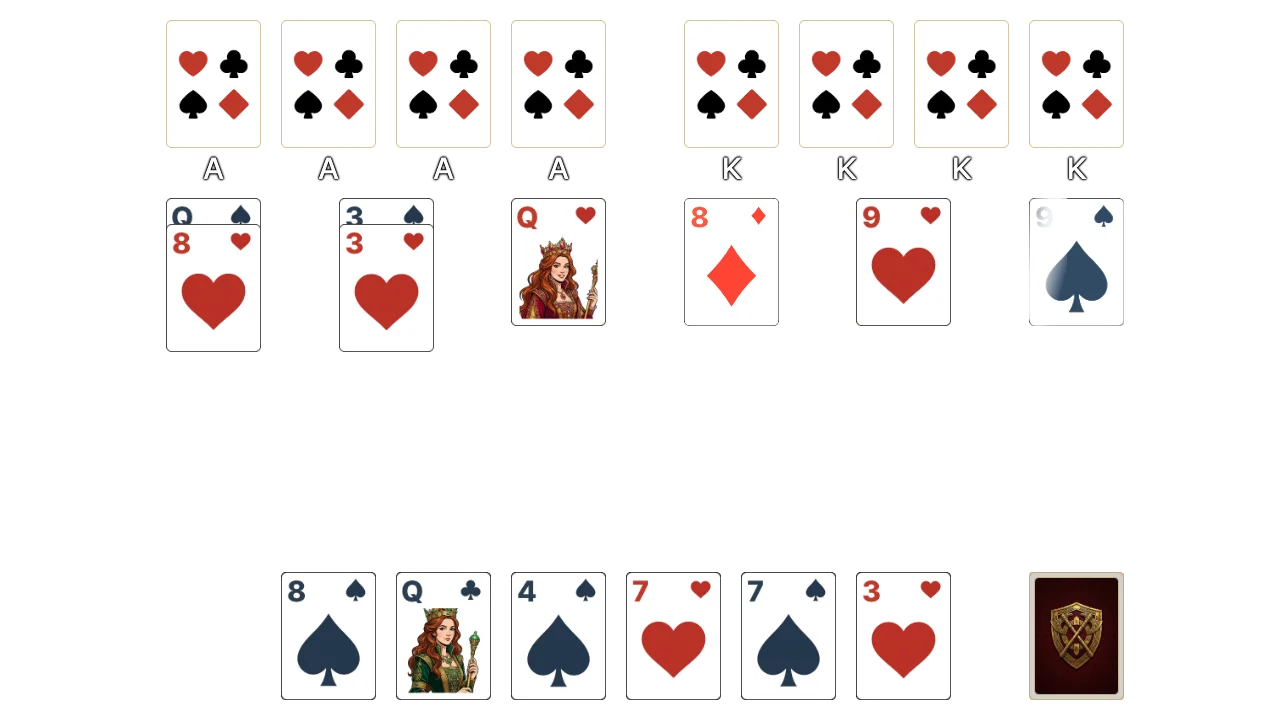
Shuffle two standard 52-card decks together (104 cards). Deal eight columns of six face-up cards each (48 cards) for the tableau. Deal six face-up cards into a single row of reserve piles below or beside the tableau. The remaining 50 cards form the stock pile, dealt one card at a time onto a face-up waste pile. Place the eight foundations — one Ace and one King of each suit — above the tableau as starting anchors (or build them as Aces and Kings become available, depending on app convention).
How to play Algerian Patience
- The eight foundations build by suit in two directions: four climb from Ace to King, four descend from King to Ace. Same suit only — no alternating colours.
- Tableau columns build down by suit only (Spades on Spades, Hearts on Hearts), one rank at a time. Unlike Klondike or FreeCell, you cannot alternate colours — same-suit only is the entire constraint.
- Only one card moves at a time between tableau columns. There are no group moves, regardless of how well-stacked the sequence is. This is the rule that makes Algerian Patience famously slow and demanding.
- Reserve piles hold a single card each and replenish from the stock when emptied. They act as buffers for cards you need to move out of the way temporarily — but each one is precious because there are only six.
- The stock pile turns over one card at a time onto a face-up waste pile. The top of the waste is always playable to foundations or tableau. No redeals in the classic version; the Relaxed variant adds them.
- An empty tableau column accepts any single card or any single card from the waste/stock. Empty columns are extremely valuable given the one-card-move restriction.
Win and loss conditions
You win when all 104 cards have been built onto the eight foundations and no cards remain in the tableau, reserves, stock, or waste. You lose when no legal move can advance any foundation and all stock cards have been exhausted. The Solitaire Royal undo button lets you backtrack costly moves; you can also restart the deal or shuffle a new one. Deals are randomly shuffled and tuned to be solvable.
Strategy & tips
- Patience is literal. The one-card-at-a-time rule means every move is a single brick in a long wall. Short-term gains often hurt long-term position — think 5-6 moves ahead before promoting a card to a foundation.
- Use reserves as buffers, not destinations. Parking a card in a reserve to unblock a column is correct; leaving it there for the rest of the game wastes a precious slot.
- Empty tableau columns are gold. With no group moves, an empty column is your main mobility tool. Don't fill it with a King until absolutely necessary, and only with a King that opens up a long playable sequence.
- Bidirectional foundations create a trap. Promoting a 7 too early to the up-foundation can lock out the 6 that the down-foundation will need. Watch both directions before committing.
- Hard and Harder variants strip away forgiving rules (no redeals, stricter reserve refills). Start with Relaxed if you're new — it preserves the strategic core while easing the punishment for early mistakes.
Algerian Patience is widely believed to have spread from French and North African colonial parlour traditions in the late 19th century, hence its name. It appears in early 20th-century European patience anthologies under variants of "La Patience Algérienne." The same-suit-only tableau and bidirectional foundations are unusually strict for the era, which is why the game gained a reputation as a connoisseur's patience — slower than Klondike, harder than FreeCell, and built for an afternoon of careful play rather than a quick session.