Goal of the game
Move all 52 cards onto the four foundations, in ascending order and by suit (Spades on Spades, Hearts on Hearts, Diamonds on Diamonds, Clubs on Clubs), from Ace to King. The game is won the moment each foundation holds the 13 cards of its suit.
Setup
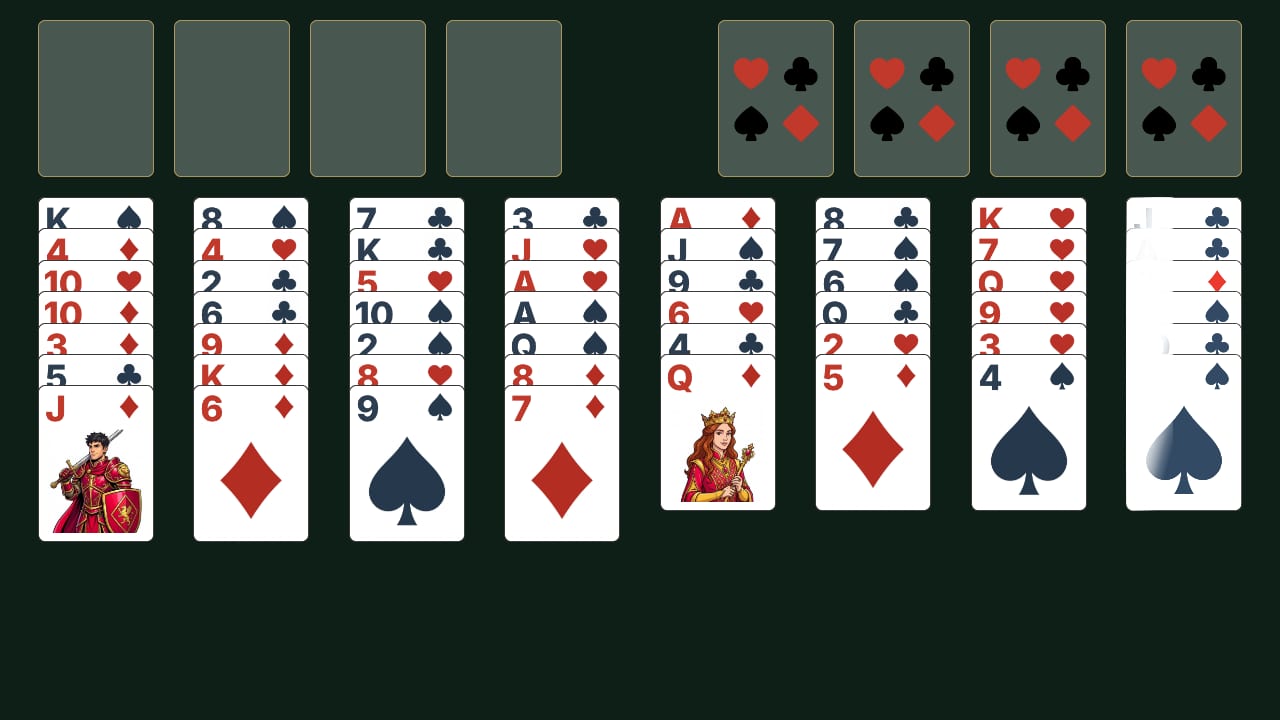
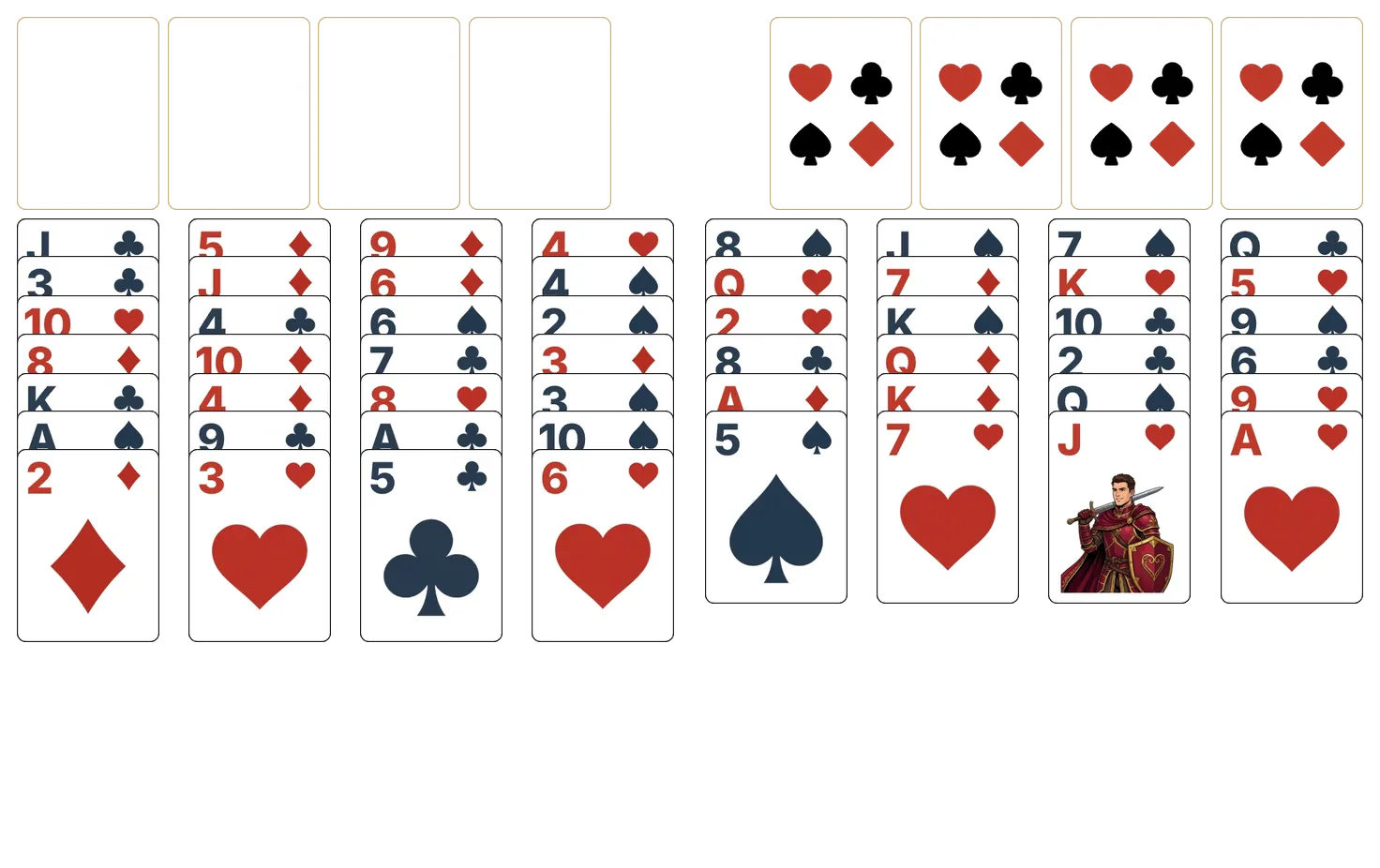
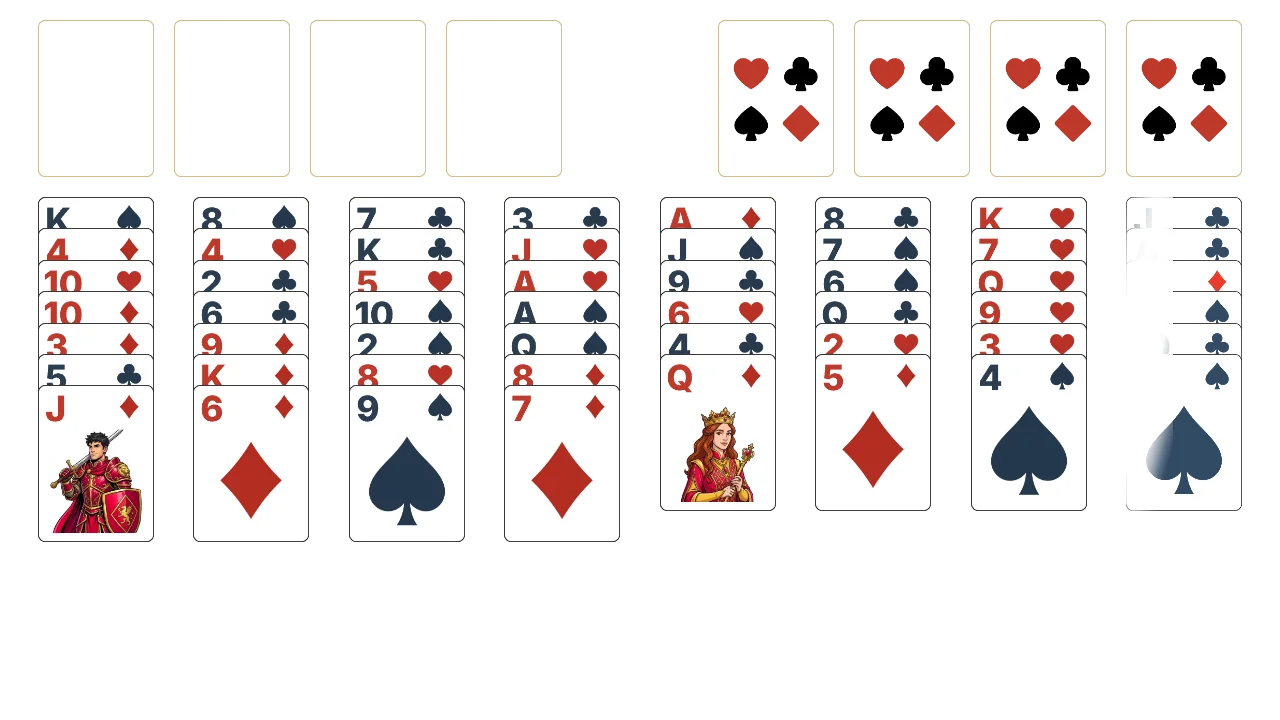
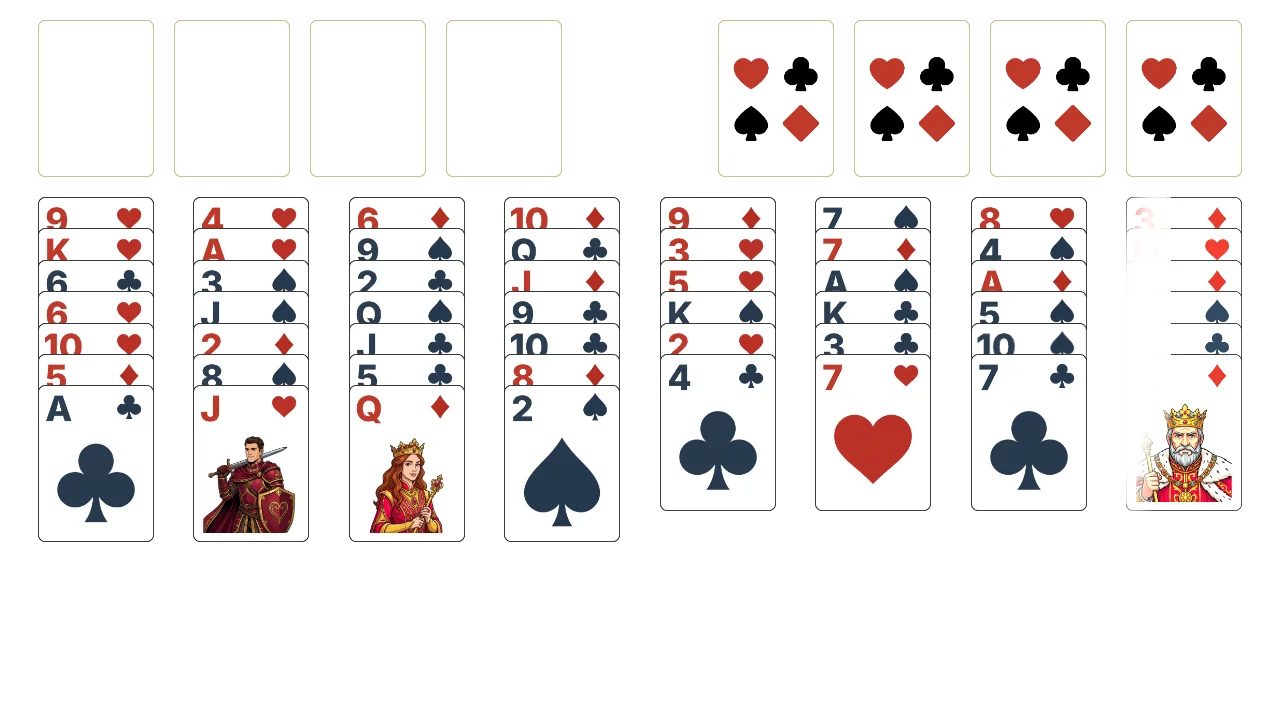
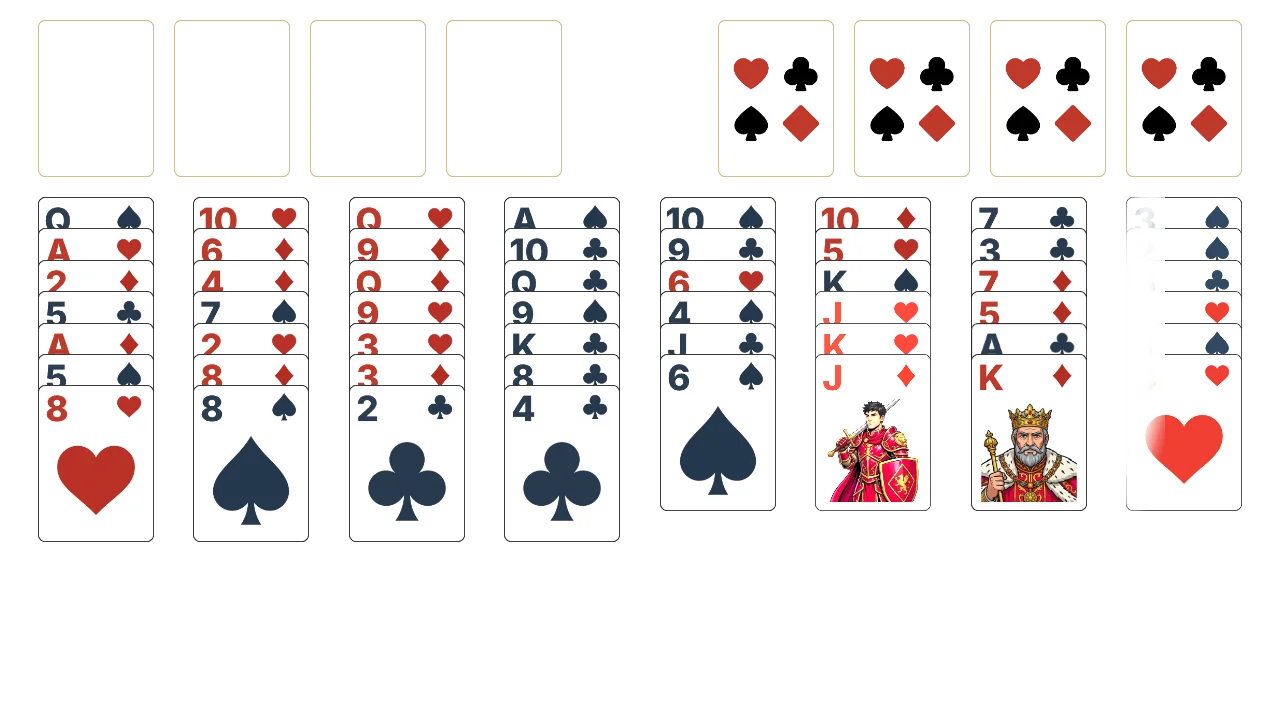
Shuffle a standard 52-card deck. Deal the cards face-up into 8 columns: the first four hold 7 cards each, the next four hold 6 cards — totalling 28 + 24 = 52 cards. Above the tableau, reserve four free cells (empty at the start) and four foundations (empty at the start, one per suit). Every card is visible from the very first move; there is no stock pile, no waste pile, and no redeal.
How to play FreeCell
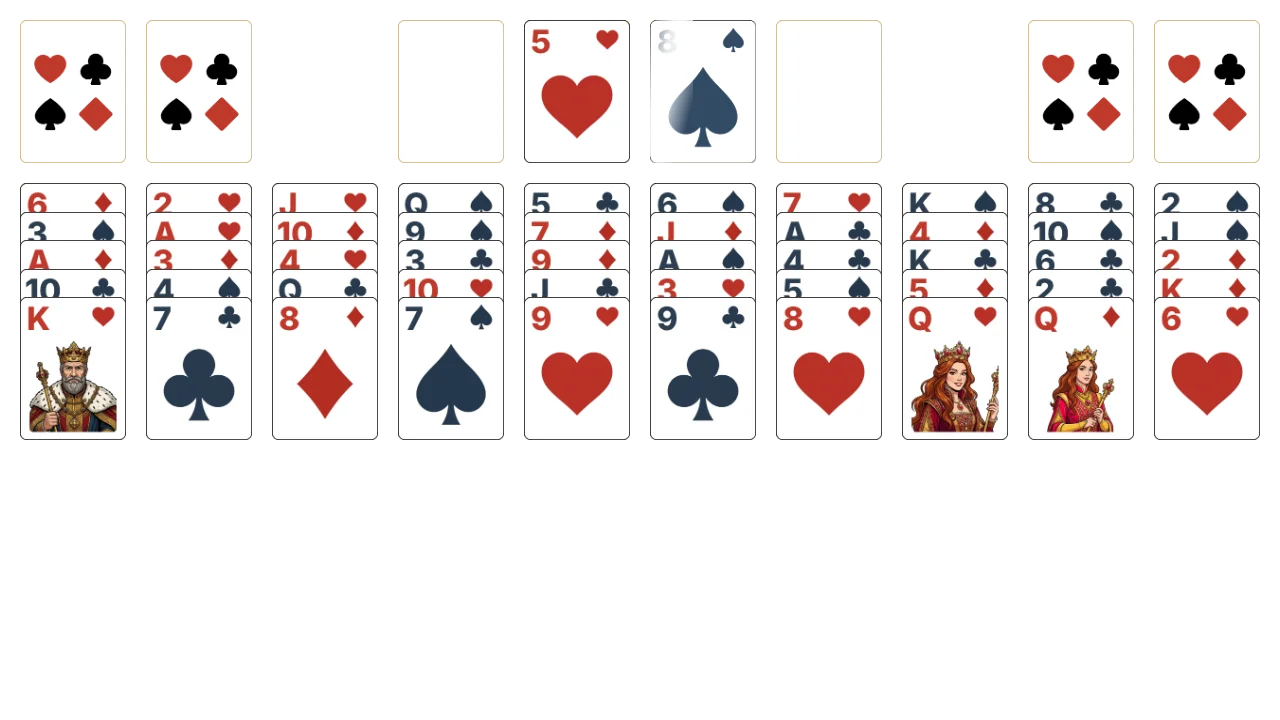
- Build the tableau columns down in alternating colours: a black 7 onto a red 8, a red 6 onto a black 7, and so on. The red-black alternation is the heart of FreeCell.
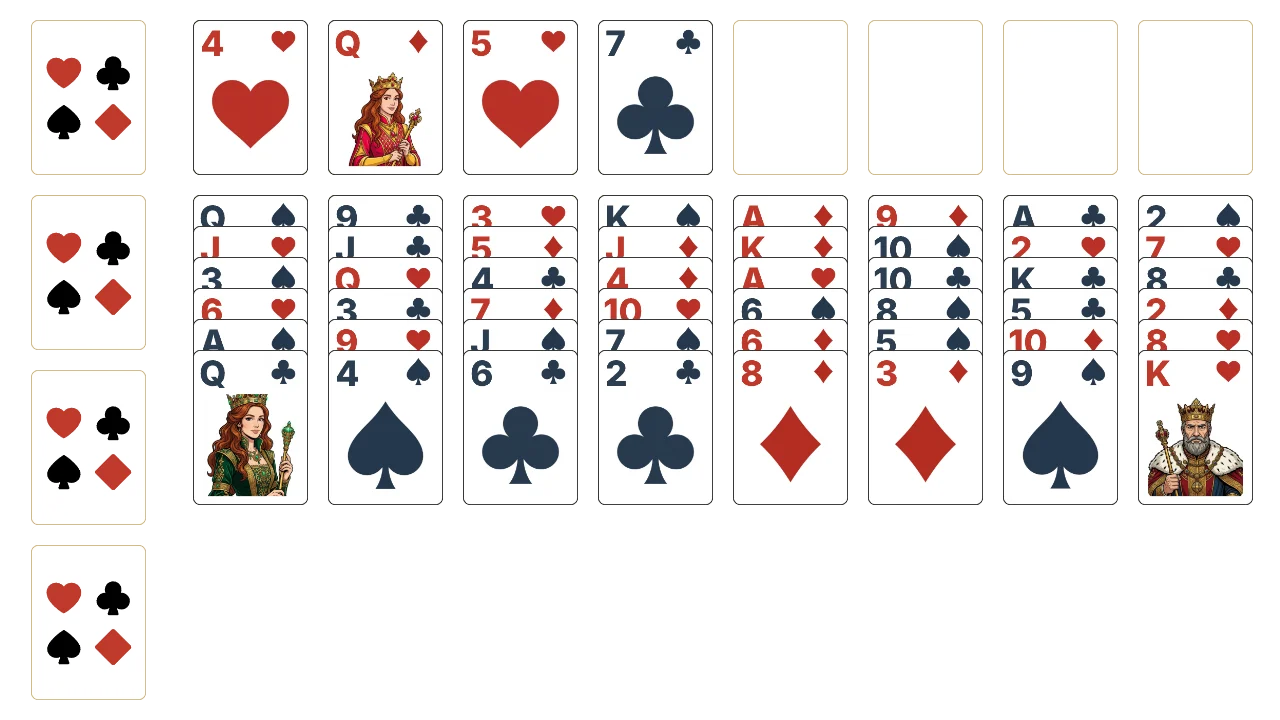
- The four free cells at the top of the board can each hold a single card of any rank. They temporarily release a blocking card so you can reach the one beneath, but an occupied cell uses up parking space and shrinks your group-move capacity.
- Foundations build up by same suit (Spades on Spades, etc.), from Ace to King. You can pull a card back from a foundation into the tableau if strategy demands it — useful for rescuing an opposite-colour bridge.
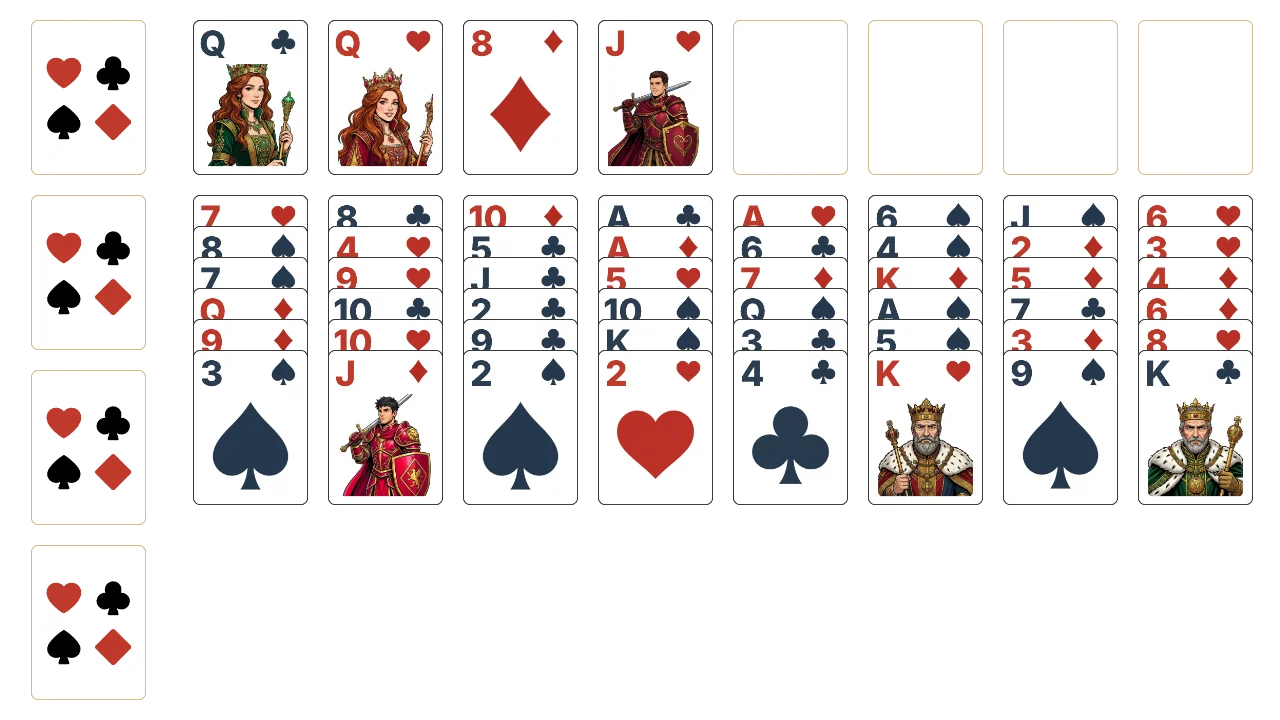
- An empty column accepts any card or group of cards. Empty columns are the most valuable resource in FreeCell: they serve as a swap space for reorganising the tableau and moving longer sequences.
- Group moves are only possible if you have enough empty free cells and empty columns. The capacity formula is (empty free cells + 1) × 2^(empty columns): 4 free + 0 empty columns = 5 cards; 4 free + 1 empty column = 10 cards; 4 free + 2 empty columns = 20 cards.
Win and loss conditions
You win the moment all 52 cards have been built up onto the four foundations, Ace-2-3-…-King for each suit. You lose if no legal moves remain — every tableau card is blocked and the free cells are full. Solitaire Royal's undo button rewinds bad moves; you can also restart the deal or shuffle a new one. Deals are randomly shuffled and guaranteed solvable.
Strategy & tips
- Plan backwards from the goal. Spot your Aces and Twos, then trace the path to liberate them before touching anything else — every move that brings an Ace closer to the foundation pays off.
- Treat free cells as savings, not pockets. Each parked card is one less you'll have to move later, but an occupied cell is also a card that no longer participates in the tableau. Avoid filling all four cells in the same turn or you'll lose all group-move capacity.
- Protect empty columns like assets. An empty column doubles your moving capacity and acts as a swap space for long sequences. Only fill it with a King as a last resort — and only with a King that opens a playable suite.
- Before promoting a card to its foundation, check whether a lower opposite-colour card might still need it as a bridge. Promoting too early — especially 5s, 6s, and 7s — can dead-end the late game by stripping a key support.
- If a classic deal stumps you, try the Relax variants (Eight Off Relaxed, Seahaven Towers Relaxed): looser group-move rules that rebuild confidence before returning to standard FreeCell.
FreeCell was invented by Paul Alfille in 1978 on the PLATO computer system at the University of Illinois — a methodical rewrite of an older patience called "Baker's Game," switching from same-suit building to alternating-colour building. The game stayed obscure until Microsoft bundled it with Windows 95 (deals numbered 1 through 32,000), where it became a worldwide hit. Deal #11,982 is famously infamous: one of the very few official deals proven unsolvable.