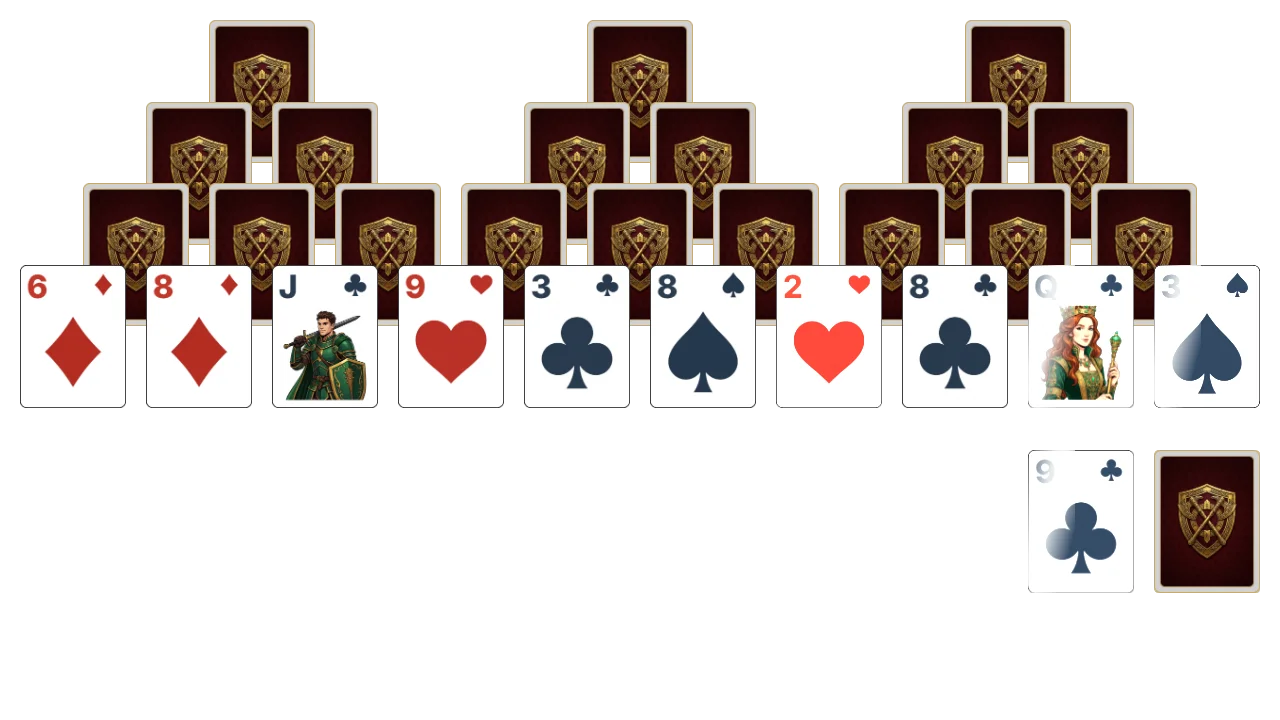
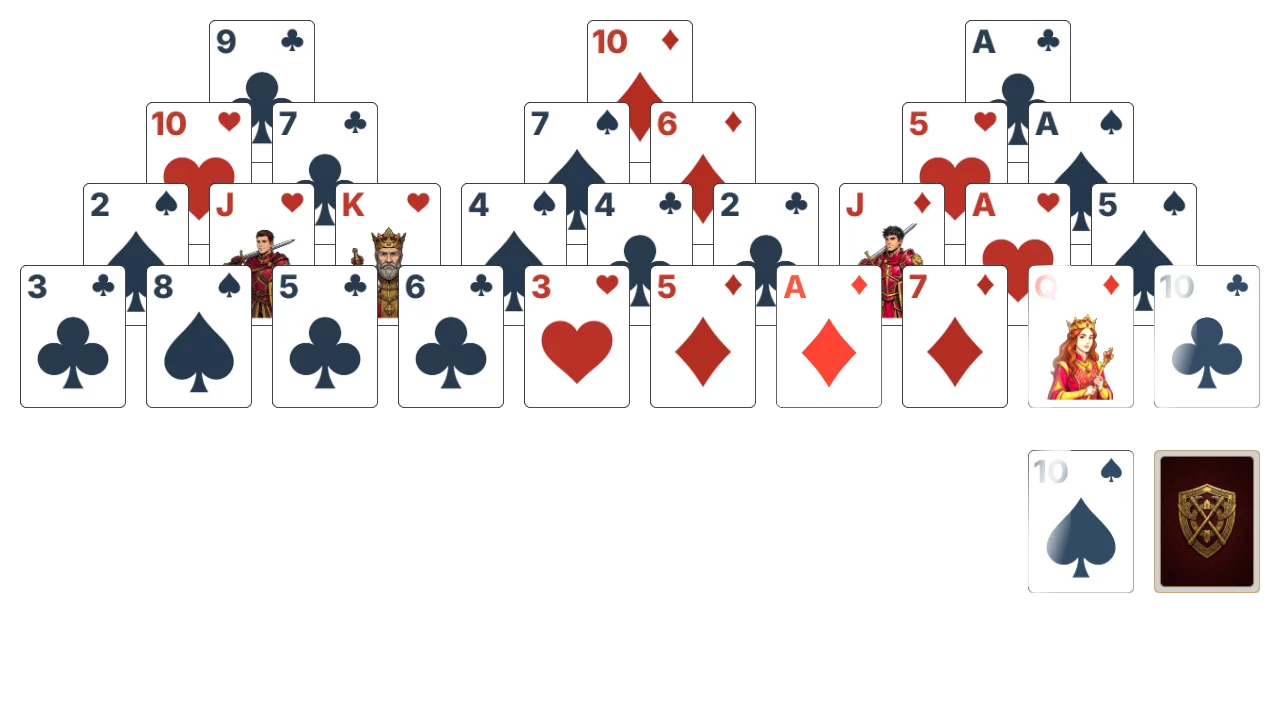
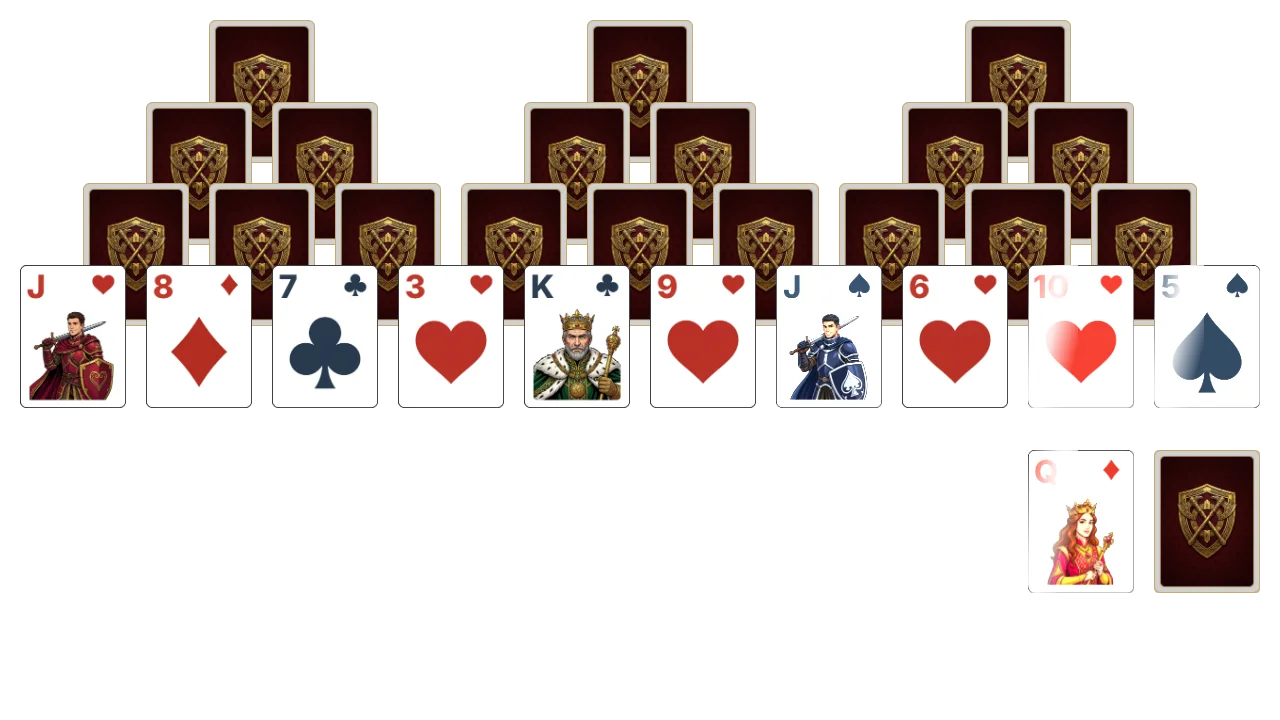
Goal of the game
Clear all 28 cards from the three peaks by playing them onto a single waste pile. Each card played to the waste must be exactly one rank above or one rank below the current top of the waste, with suit ignored. The game is won when all three peaks are empty — the cards from the base row don't count for victory, only the three peaks do (in the classic ruleset).
Setup
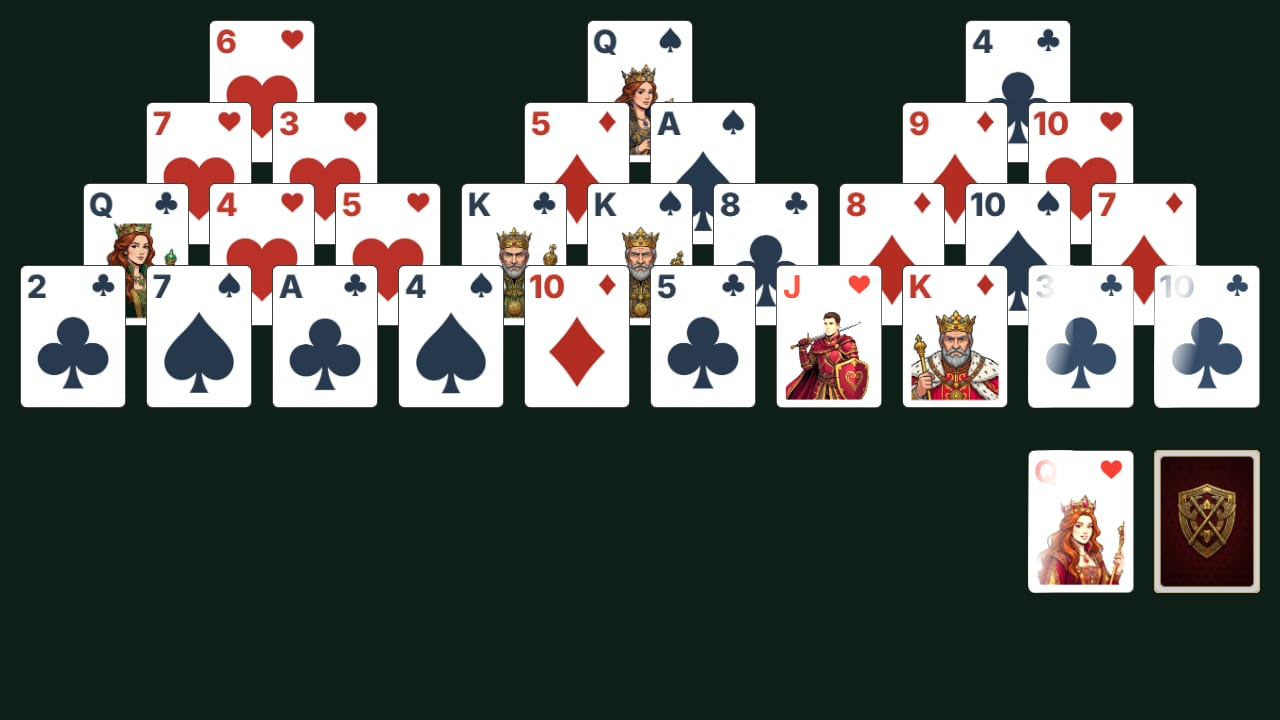
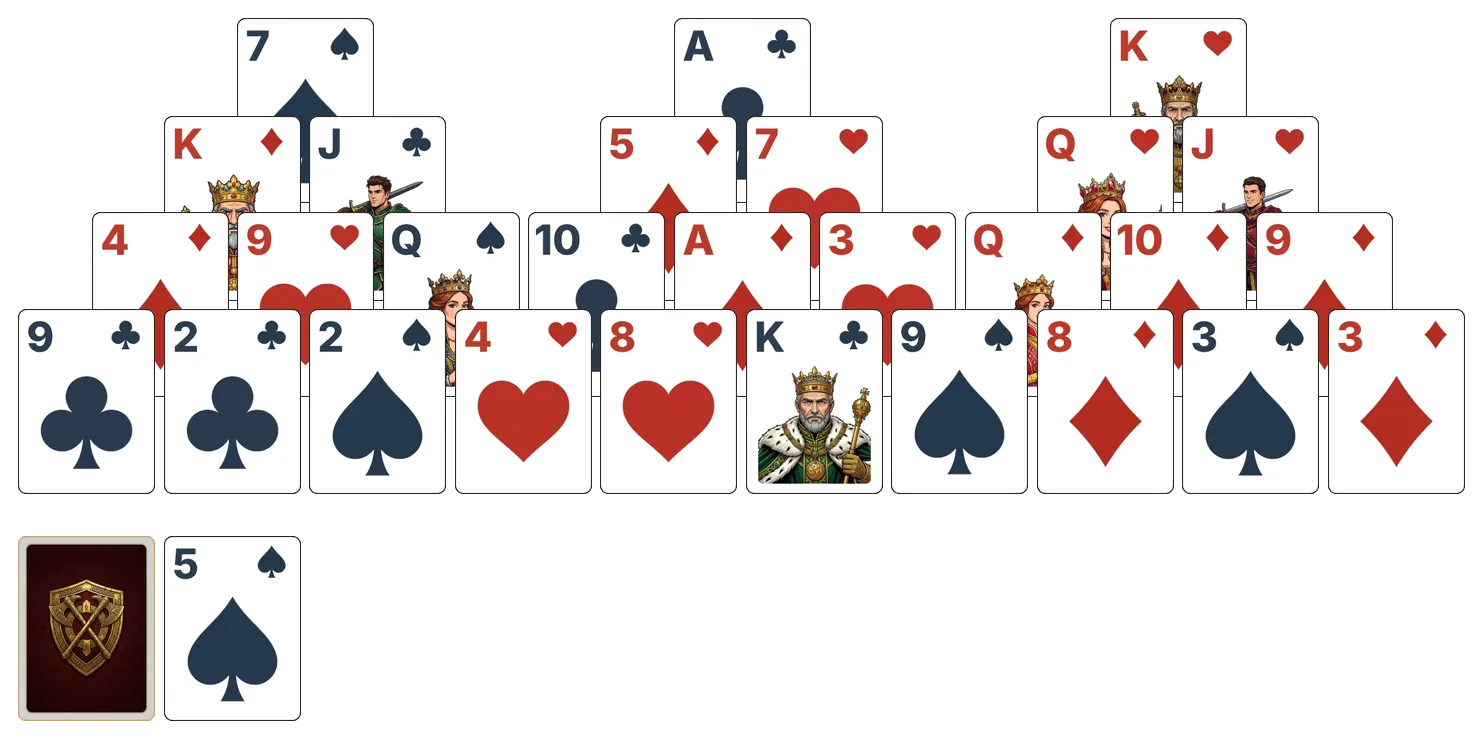
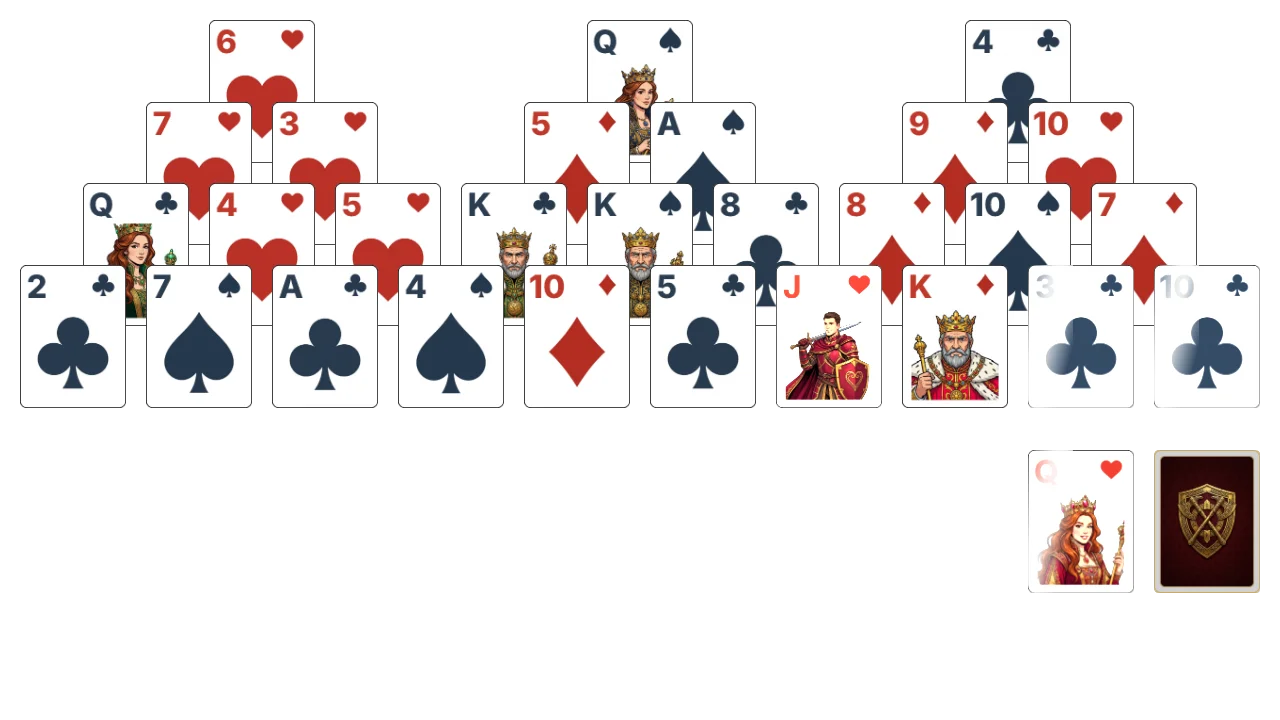
Shuffle a standard 52-card deck. Deal 28 cards face-down into three overlapping peaks at the top of the layout, each peak shaped as a small pyramid: 1 card at the top, 2 below, 3 below those (6 cards total per peak × 3 peaks = 18 cards), plus a base row of 10 face-up cards beneath the peaks that connect all three. The remaining 24 cards form the stock pile, dealt one card at a time onto a face-up waste pile.
How to play Tri Peaks
- A peak card is "exposed" (playable) when both cards immediately below it have been removed. Cards on the base row are exposed from the start. Cards in the peaks themselves are face-down until their two children are cleared.
- Move any exposed peak or base-row card onto the waste if its rank is exactly one above or one below the top of the waste, regardless of suit. A 7 plays onto a 6 or an 8; suit doesn't matter.
- The rank sequence is circular: Aces wrap to Kings and Kings wrap to Aces. This means an Ace plays onto a King or a 2, and a King plays onto a Queen or an Ace. Long combos can roll through the full deck range.
- When no exposed card matches the waste's top rank (±1), flip the next stock card to the waste. This breaks the chain but starts a new one. The longer the chain before a stock flip, the higher the score.
- Win when all three peaks are cleared. The 24 base-row cards and remaining stock don't need to be cleared in the classic version. Some Strict variants require the base row to be cleared as well.
Win and loss conditions
You win when the three peaks are completely cleared. You lose when the stock is exhausted, no exposed card matches the waste's top rank ±1, and no more moves are possible. Score is calculated from chain length: a chain of N consecutive plays earns 1+2+3+...+N points (so a 10-card chain is worth 55 points vs ten isolated plays at 1 point each = 10). Solitaire Royal's undo button lets you backtrack costly chain breaks; you can also restart the deal or shuffle a new one.
Strategy & tips
- Hunt for the longest possible chain before tapping the stock. Score grows quadratically with chain length — a 10-card chain (55 pts) is worth far more than two 5-card chains (15 pts each = 30 pts). Plan ahead to find branching paths.
- Take cards that unlock two children at once. A peak-row card sits above two cards; removing it exposes both. Removing a corner card only exposes one. Prefer interior cards when scoring matters.
- Don't strand a critical bridge card under cards you still need. If the only 5 in the layout is buried under three 2s, you may dead-end the late game. Look at what each peak card unlocks before committing.
- Watch the Ace-King wrap. Many beginners miss that you can chain Ace → King → Queen or vice versa. Long chains often pivot through this circular boundary — train your eye to see it.
- Try the Strict and Hidden variants for harder play. Strict requires clearing the base row too; Hidden makes the peak cards remain face-down until their children are cleared, hiding what's possible. Both raise the strategic ceiling significantly.
Tri Peaks was designed in 1989 by Robert Hogue at Microsoft (according to Hogue's own accounts) as a successor to Pyramid solitaire, intended to offer faster pacing and higher visual reward. It was first widely distributed in Microsoft Entertainment Pack 4 in 1991 and later included in successive Windows releases. The rolling-rank-by-one mechanic was directly inherited from Golf solitaire (1930s origin), but the three-peak layout and chain-scoring system are Hogue's contributions — and they made Tri Peaks one of the most-played solitaire games of the 1990s and 2000s, second only to Klondike and FreeCell.