Goal of the game
Build each of the twelve foundations to its target — top row 2 → 5 → 8 → J, middle row 3 → 6 → 9 → Q, bottom row 4 → 7 → 10 → K. All foundations build up by suit in steps of three. The game is won when every foundation has reached its Jack, Queen, or King respectively, exhausting the deck.
Setup
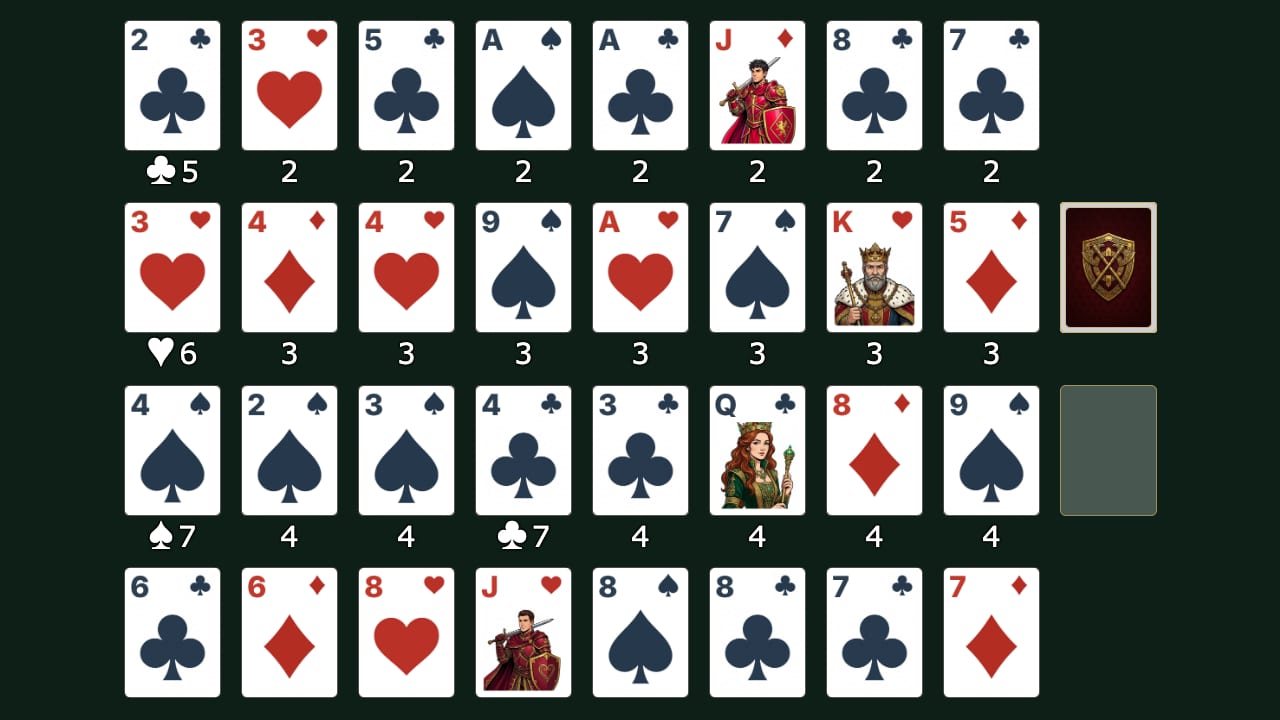
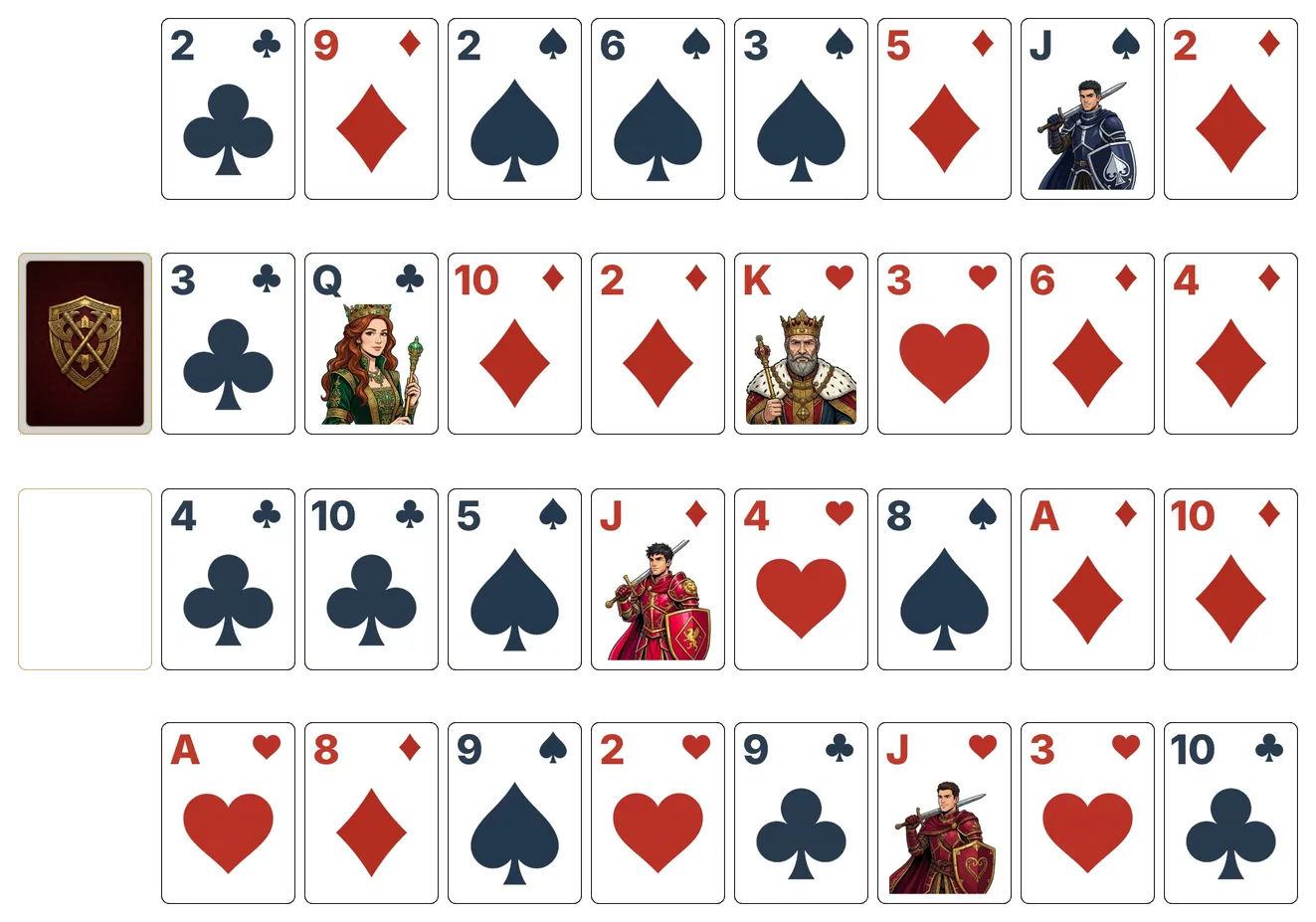
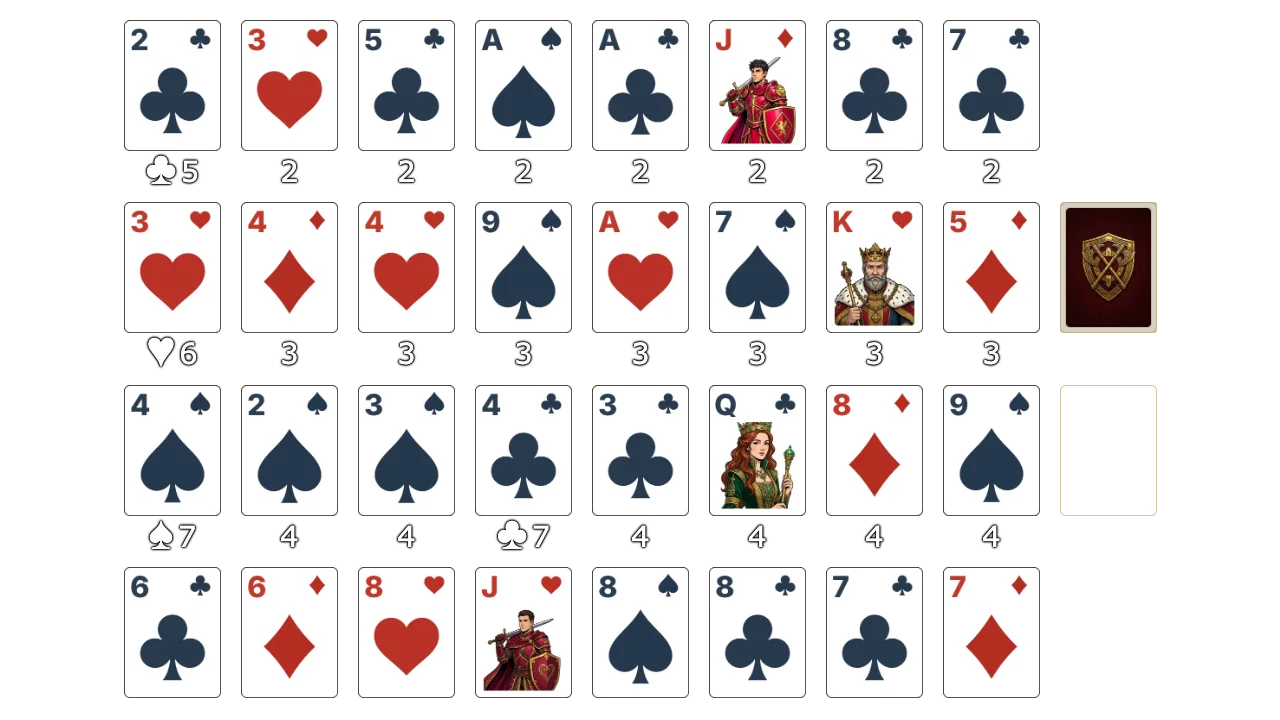
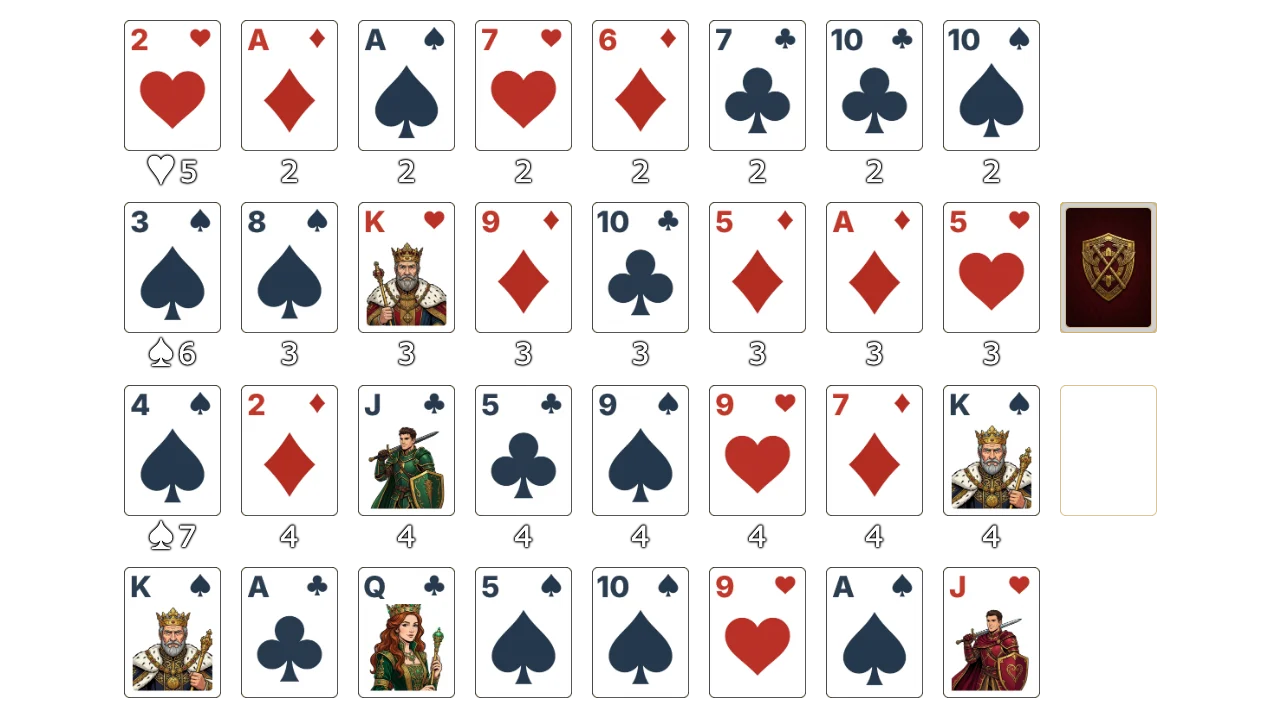
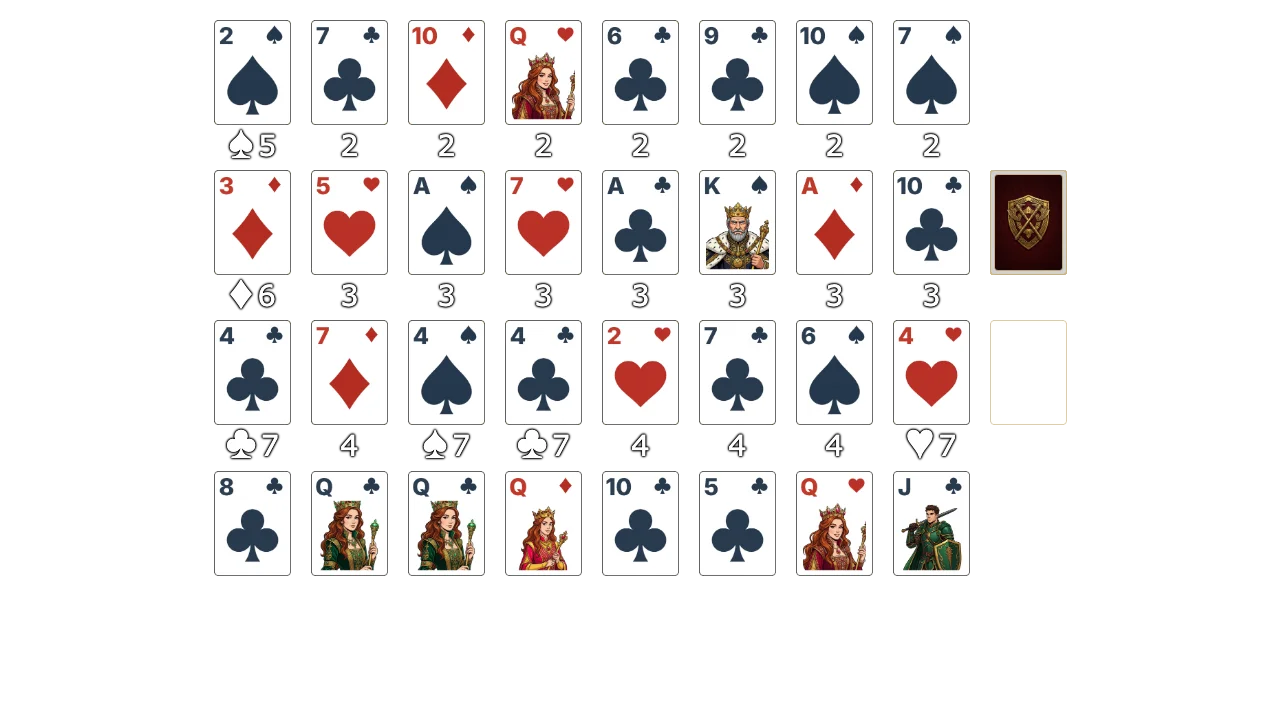
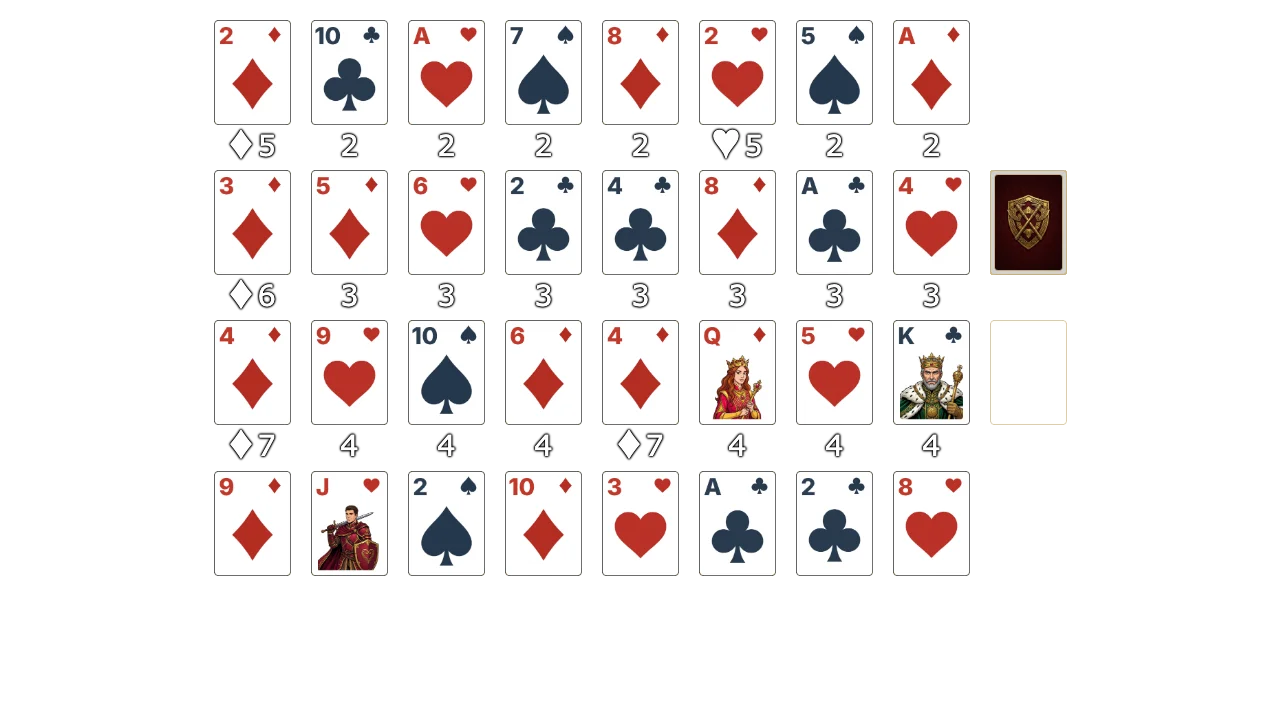
Shuffle a standard 52-card deck. Deal 24 cards face-up into three rows of eight slots — the parade. As 2s, 3s, and 4s appear in the deal they move into their correct row (top row for 2s, middle for 3s, bottom for 4s); other ranks sit in their dealt slot for now. The remaining 28 cards form the stock pile. The top of the stock is always face-up and immediately playable.
How to play Royal Parade
- The twelve foundations build up by suit in steps of three. A foundation starting at 2♠ accepts 5♠, then 8♠, then J♠; a foundation starting at 3♥ accepts 6♥, 9♥, Q♥; and so on.
- Cards in the parade can be promoted to a foundation if they fit. When a parade slot empties, refill it from the stock pile or move another parade card into the gap — only the top of the stock is available.
- Empty parade slots are valuable. They serve as temporary holding spots: park a card you don't yet need so the stock keeps revealing useful cards.
- The stock pile is dealt face-up one card at a time. You can either play the top stock card onto a foundation, into an empty parade slot, or leave it and deal the next card.
- Two redeals are permitted. A redeal takes any unplayed stock cards plus the discarded cards and shuffles them back into a fresh stock pile. Use them sparingly.
Win and loss conditions
You win when all twelve foundations have built up to Jack, Queen, or King for their row and no cards remain in the stock or parade. You lose when the stock is exhausted, both redeals are spent, and no legal move advances any foundation. Solitaire Royal's undo lets you backtrack costly choices; you can also restart the deal or shuffle a new one. Deals are randomly shuffled and guaranteed solvable.
Strategy & tips
- Lock in the 2s, 3s, and 4s first. The starting row positions only matter once all twelve base ranks are placed — until then the parade is half a layout. Use early redeals if any base cards stay stubbornly buried.
- Empty parade slots are your most flexible resource. Don't fill one just because you can; hold it open as a swap space until a critical card needs it.
- Stepped foundations skip ranks. A 6♣ on the middle row needs a 9♣ next — meaning the 7♣ and 8♣ are dead weight on that foundation. Plan around what each foundation actually wants.
- Redeals reshuffle: order is lost. Don't trigger a redeal expecting a specific card — only do it when the current sequence is genuinely stuck.
- Watch the bottom row. The 4 → 7 → 10 → K progression is the longest chain and most likely to dead-end if a key middle rank is misplaced.
Royal Parade traces back to 19th-century European patience compilations, where it appeared under the names Hussars (English military theme) and Financier (French). The stepped-foundation mechanic — building in increments of three rather than one — was unusual enough that the game survived multiple regional renaming waves. It became one of the standard mid-difficulty patiences in mid-20th-century English and French solitaire anthologies, and remains popular today as a spatial-planning alternative to the Ace-to-King grind of Klondike.