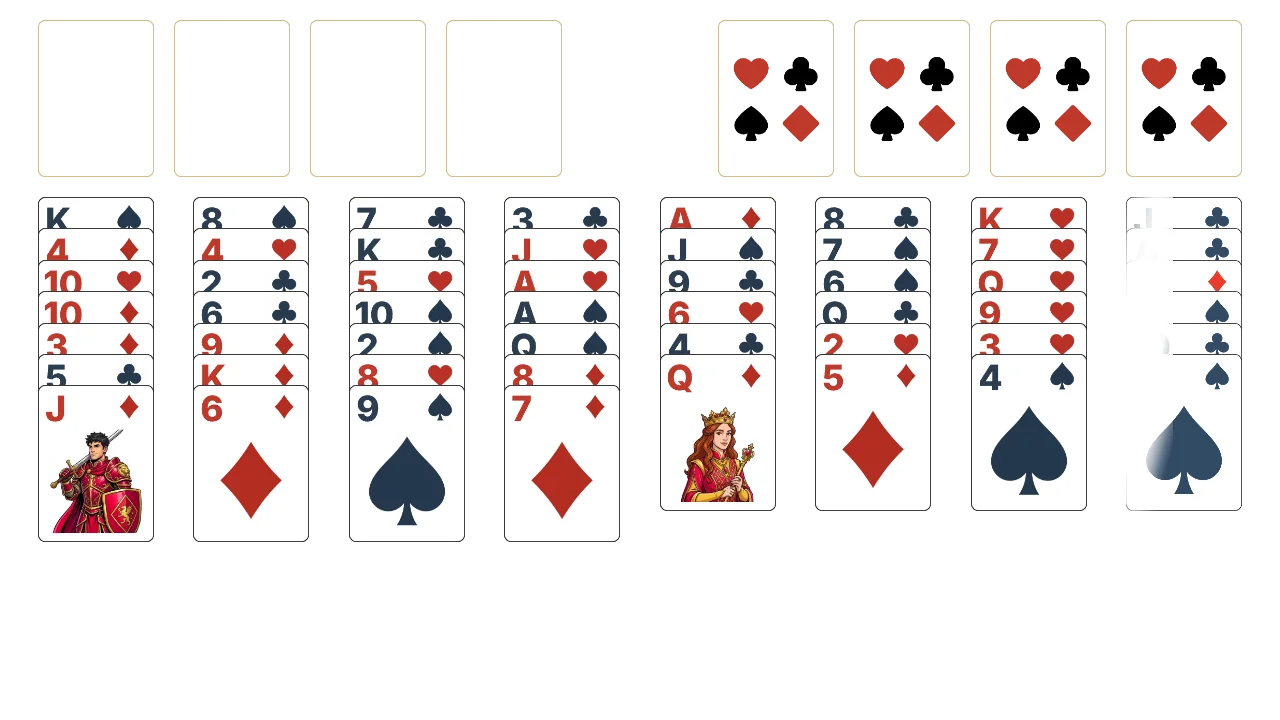
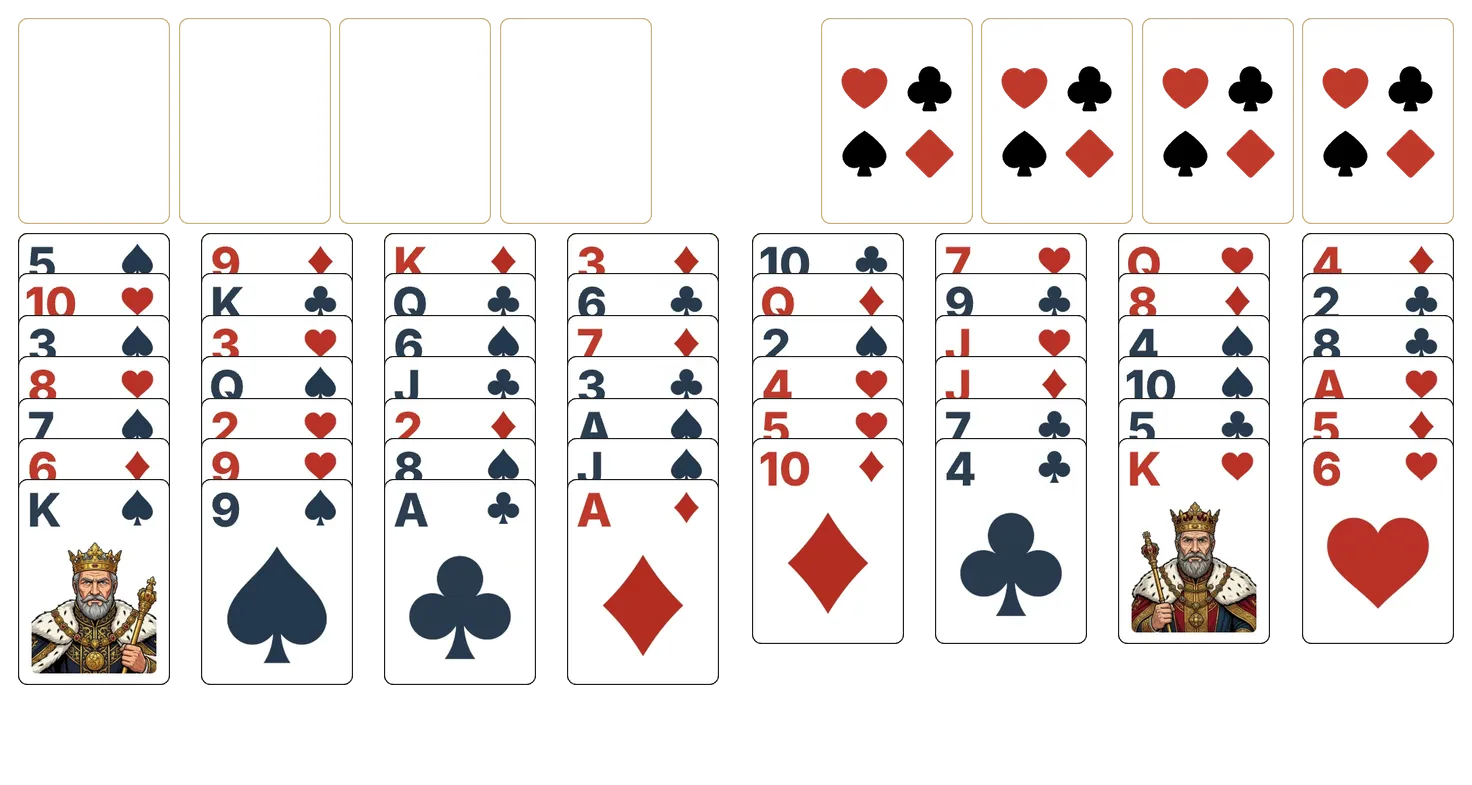
Como jogar Baker's Game
Objetivo - Mova todas as cartas para a Fundação (Foundation)
Baralhos (Decks)
- Um baralho padrão (52 cartas)
Redistribuições (Redeals)
- Não
Fundação (Foundation)
- Construída de forma ascendente por naipe de Ás a Rei
- A carta do topo de cada pilha está disponível para mover
Tableau
- Construída de forma descendente por naipe
- A carta do topo de cada pilha está disponível para mover
- Um grupo de cartas na sequência correta pode ser movido desde que haja Células (Cell) e pilhas do Tableau vazias suficientes disponíveis
- Um espaço vazio pode ser preenchido com qualquer carta ou pilha com valor correto
Célula (Cell)
- Pode conter 1 carta
- A carta do topo de cada pilha está disponível para mover
Estratégia e dicas
- Plan backwards from the goal. Spot your Aces and Twos, then trace the path to liberate them before touching anything else — every move that brings an Ace closer to the foundation pays off.
- Treat free cells as savings, not pockets. Each parked card is one less you'll have to move later, but an occupied cell is also a card that no longer participates in the tableau. Avoid filling all four cells in the same turn or you'll lose all group-move capacity.
- Protect empty columns like assets. An empty column doubles your moving capacity and acts as a swap space for long sequences. Only fill it with a King as a last resort — and only with a King that opens a playable suite.
- Before promoting a card to its foundation, check whether a lower opposite-colour card might still need it as a bridge. Promoting too early — especially 5s, 6s, and 7s — can dead-end the late game by stripping a key support.
- If a classic deal stumps you, try the Relax variants (Eight Off Relaxed, Seahaven Towers Relaxed): looser group-move rules that rebuild confidence before returning to standard FreeCell.
Origem e história
Described in print by C.L. Baker, FreeCell's intellectual ancestor. Paul Alfille relaxed the suit constraint in Baker's Game to invent FreeCell.