Goal of the game
Move all 104 cards (two complete decks) onto the eight foundations by suit. Four foundations build up from Ace to King; four foundations build down from King to Ace. The game is won when the up-built and down-built foundations of the same suit meet in the middle — typically with a 7 or 8 as the final card placed.
Setup
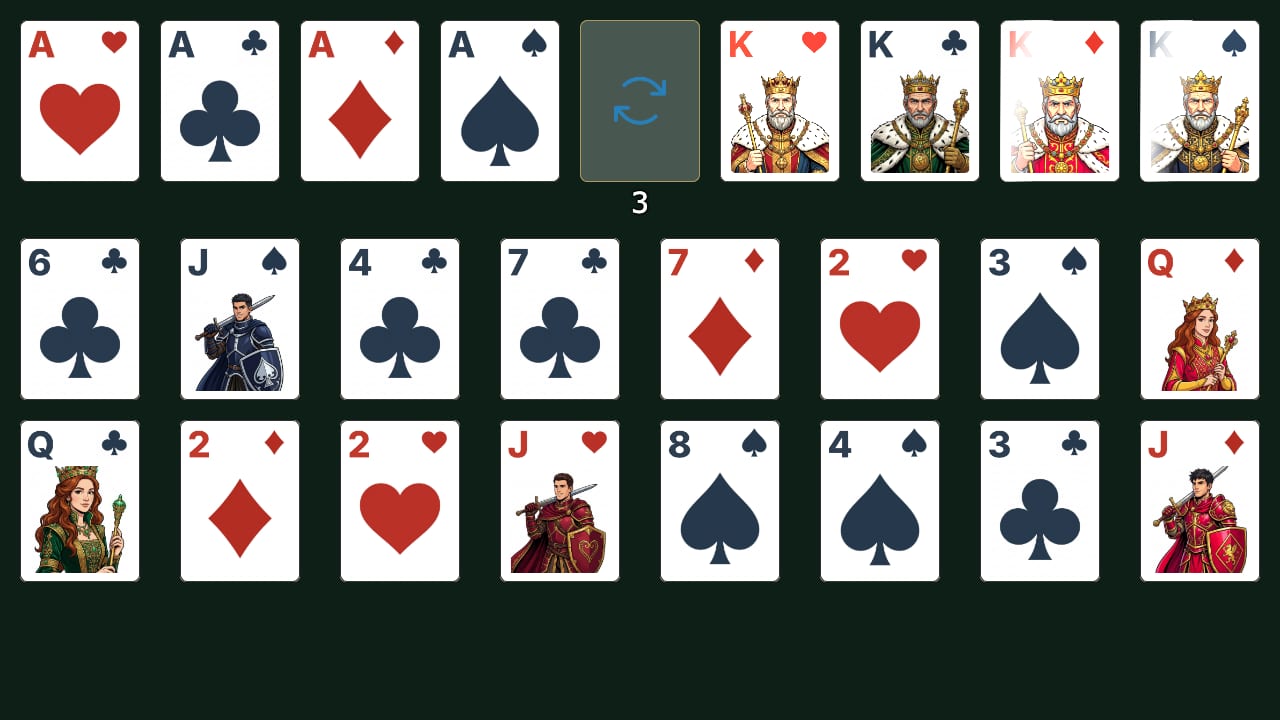
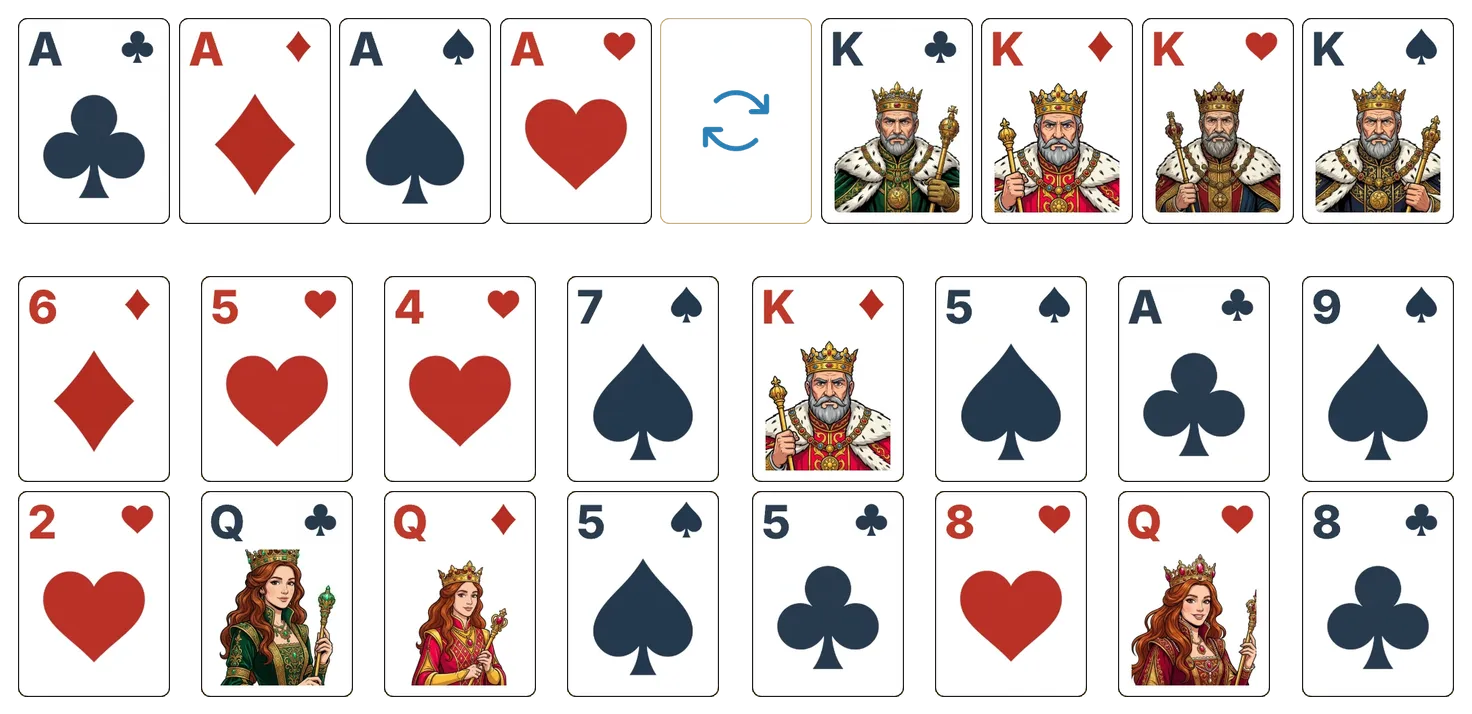
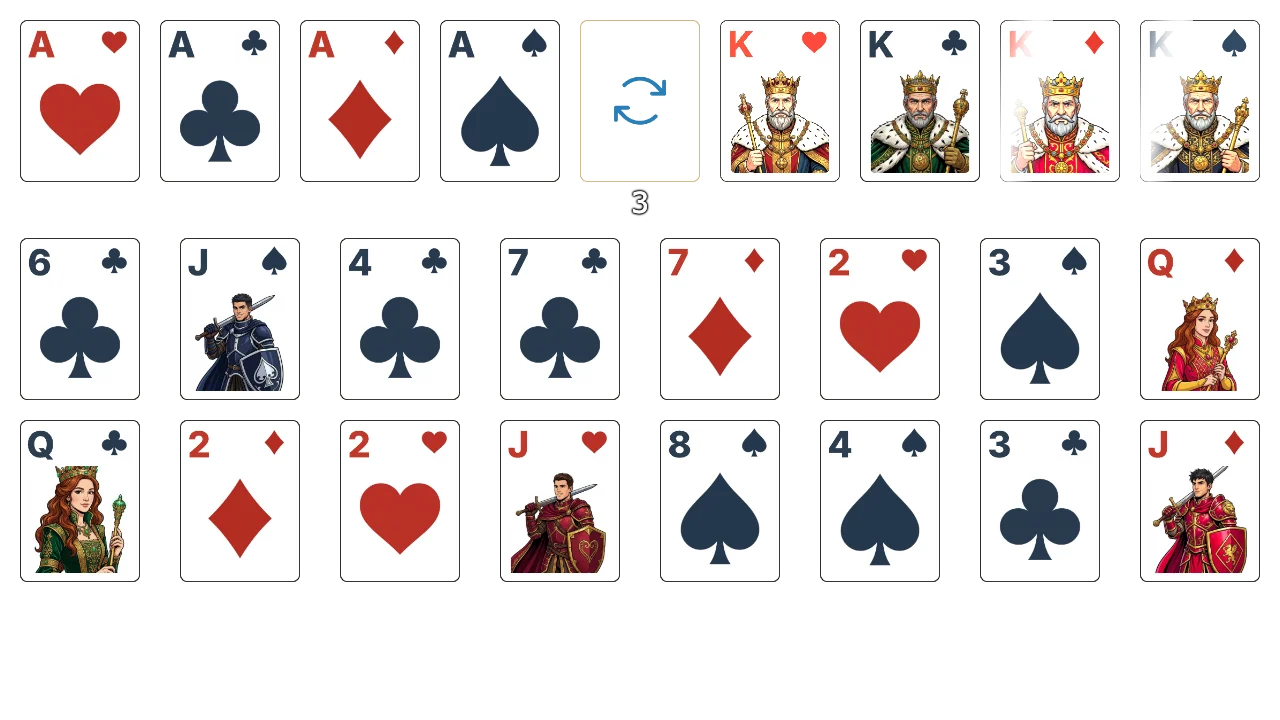
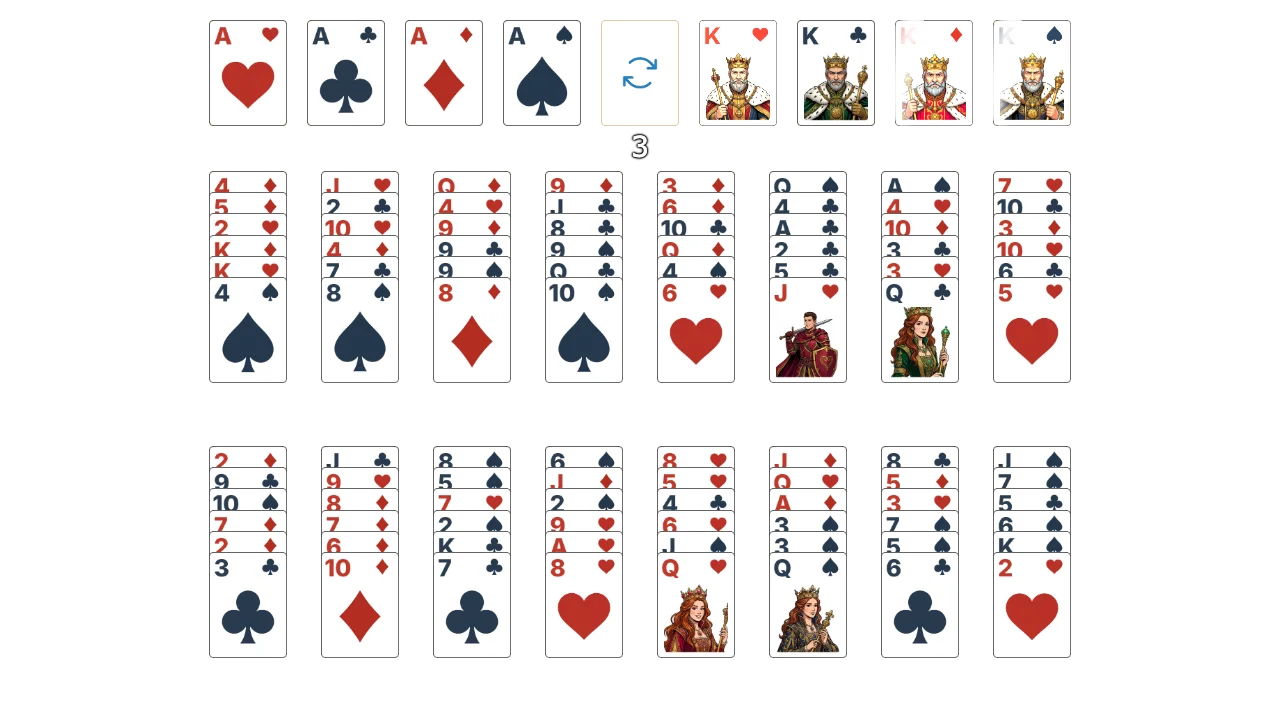
Shuffle two standard 52-card decks together (104 cards). Place one Ace and one King of each suit as the eight foundation piles in the centre — four Aces below, four Kings above (or vice versa, layout varies). Deal the remaining 96 cards into 16 reserve piles of 6 cards each, arranged in a crescent (half-moon) around the foundations. Only the top card of each reserve pile is in play.
How to play Crescent
- The eight foundations build by suit in two directions: four pile up from Ace through King, four pile down from King through Ace. Same suit only — Spades on Spades, Hearts on Hearts, and so on.
- Only the top card of each of the 16 reserve piles is available. You can move it onto a foundation, or onto another reserve pile if it continues a same-suit sequence in either direction (e.g. 5♥ onto 4♥ or onto 6♥).
- Sequential same-suit groups can be moved between reserve piles as a unit — useful for unblocking buried Aces, Kings, or middle ranks.
- Three redeals are available. Each redeal takes the bottom card of every reserve pile and rotates it to the top, dramatically reshuffling what's playable. Use them deliberately: they're your main escape from a stuck position.
- The Relaxed variant Solitaire Royal offers grants additional redeals, lowering the difficulty for learners while keeping the unique bidirectional rhythm.
Win and loss conditions
You win when both halves of every suit's foundations have built towards each other and exhausted all cards — typically meeting at the 7 and 8 of each suit. You lose when no legal moves remain and all redeals have been used. The Solitaire Royal undo button lets you rewind costly moves; you can also restart the deal or shuffle a new one. Deals are randomly shuffled and tuned to be solvable.
Strategy & tips
- Plan bidirectionally. A card you'd happily promote to the up-foundation might be the only bridge a down-foundation needs — and vice versa. Look at both directions before committing.
- Redeals are precious. Don't spend the first one until you've genuinely exhausted simple moves. Three is plenty for most deals if you read the board carefully.
- Watch for buried Aces and Kings. They start as foundations, but second-deck Aces and Kings buried in reserves can paralyse the meeting point. Free them early.
- Group moves multiply your power. A short same-suit sequence (e.g. 8♣-7♣) on one reserve can sometimes leapfrog onto another to bridge an awkward gap.
- If the classic game stumps you, try Crescent Relaxed: more redeals, looser group rules, perfect for learning the bidirectional flow.
Crescent's distinctive half-moon layout dates to late-19th-century European patience books, where its decorative geometry was as much the point as the gameplay. The bidirectional foundations and three-redeal mechanic were standardised in mid-20th-century English solitaire collections, and the game has remained a fan favourite among two-deck enthusiasts for the unusual rhythm — building towards the middle rather than racing from Ace to King in one direction.