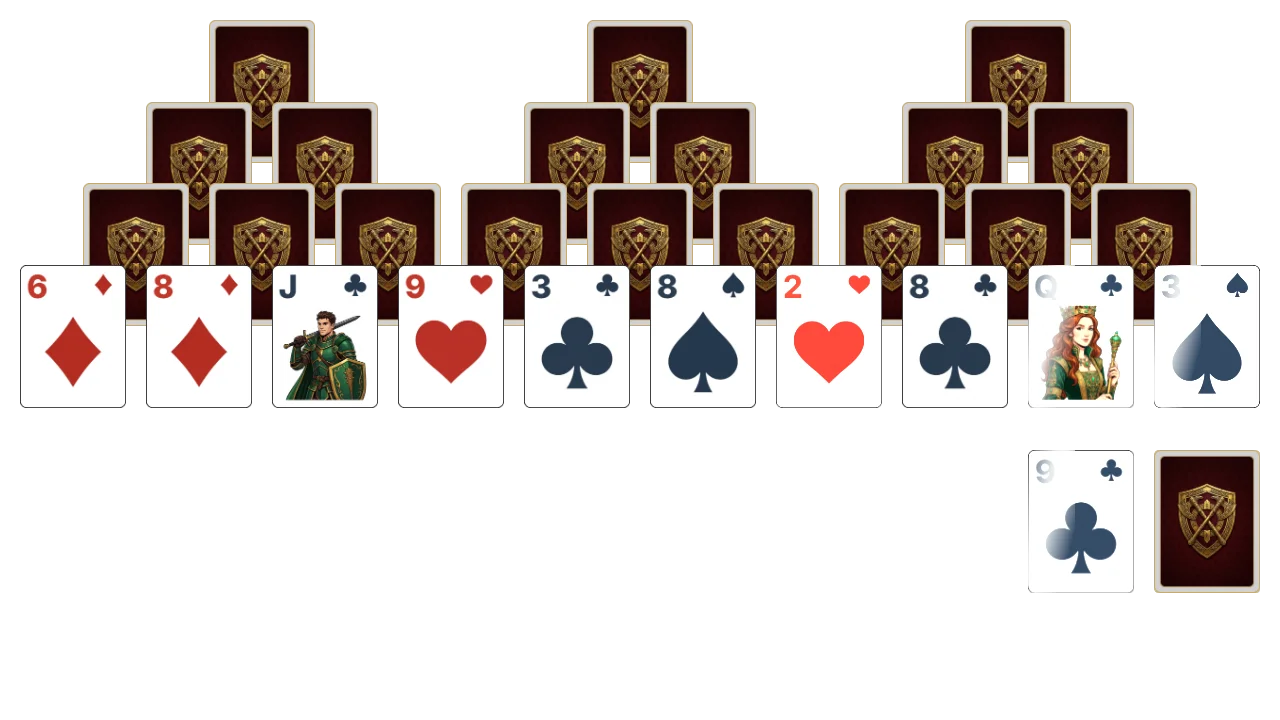
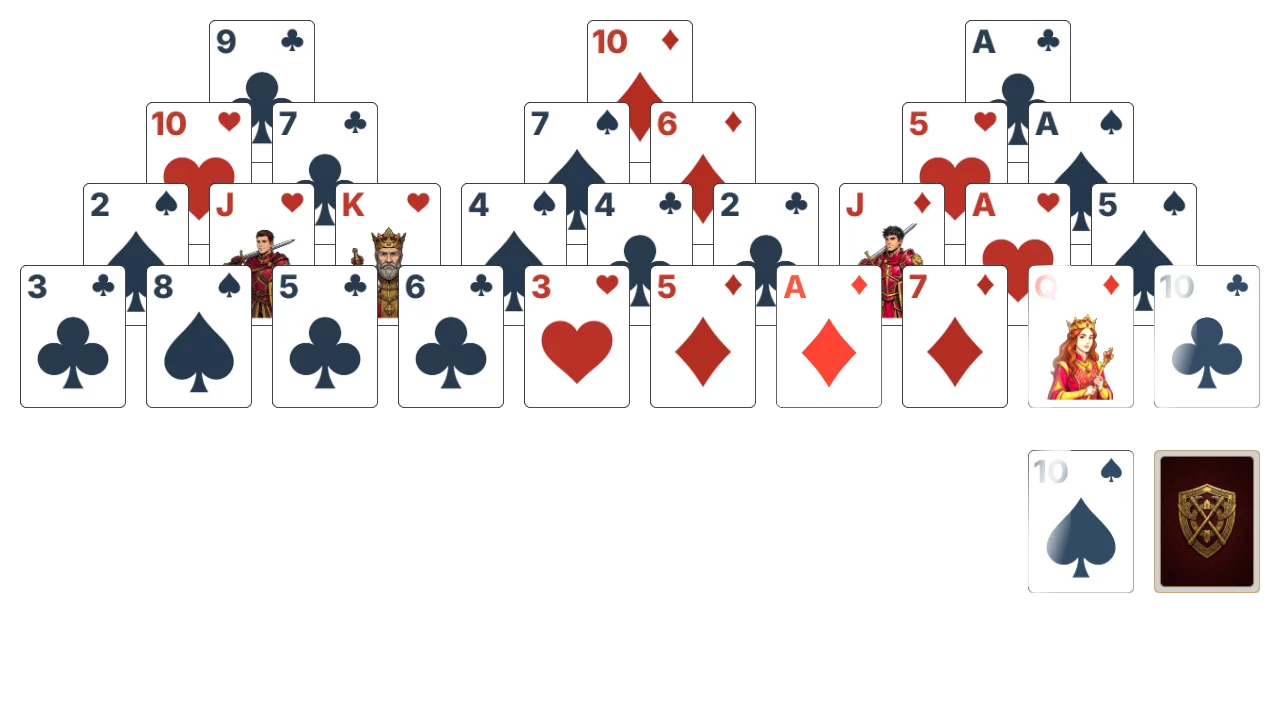
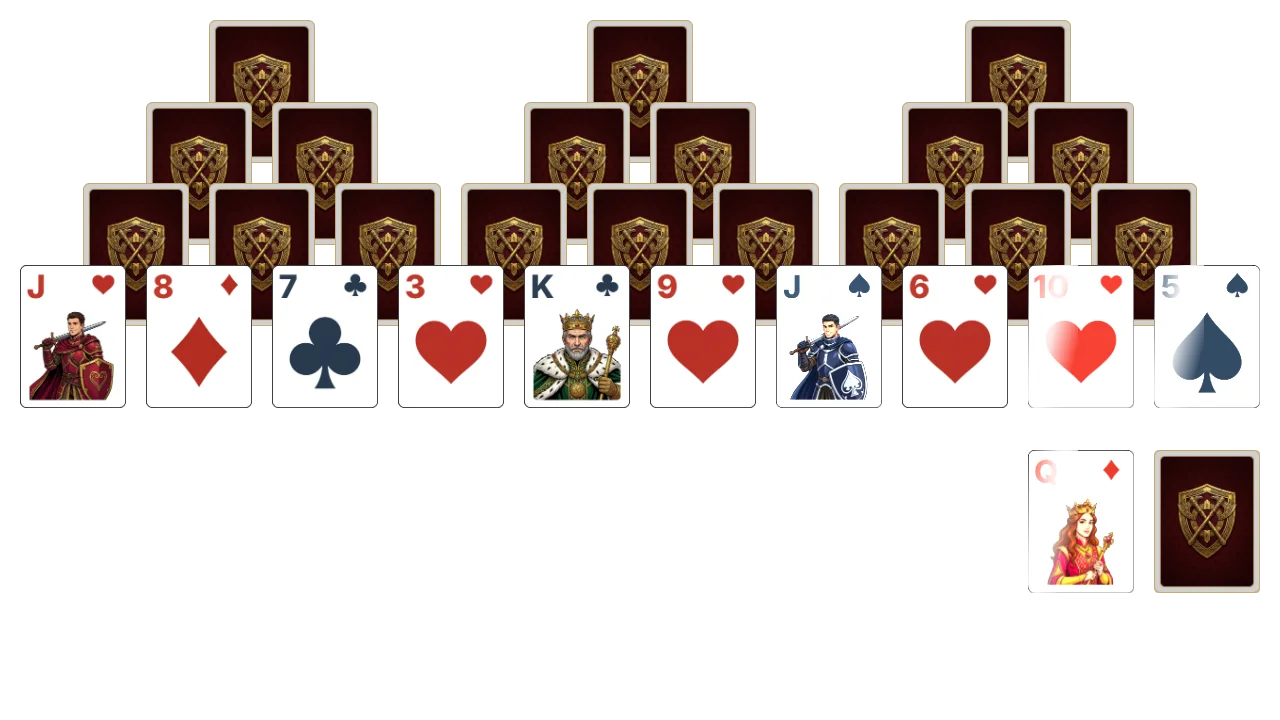
Goal of the game
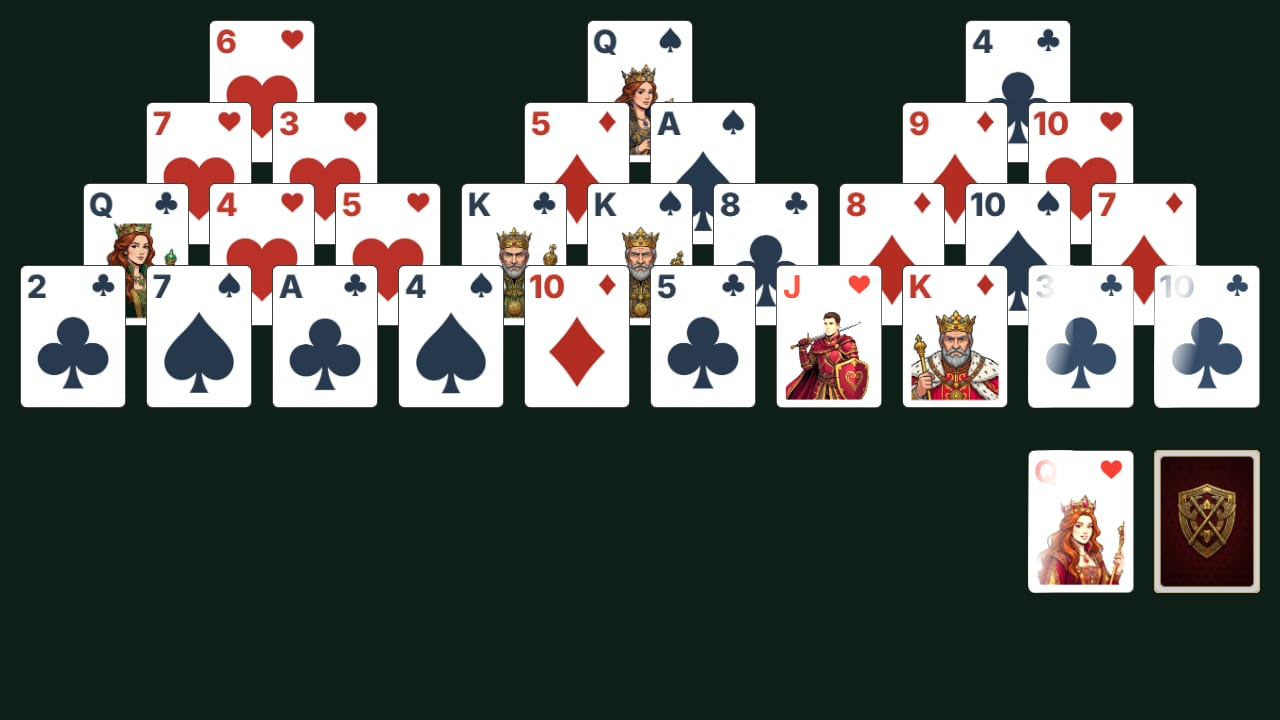
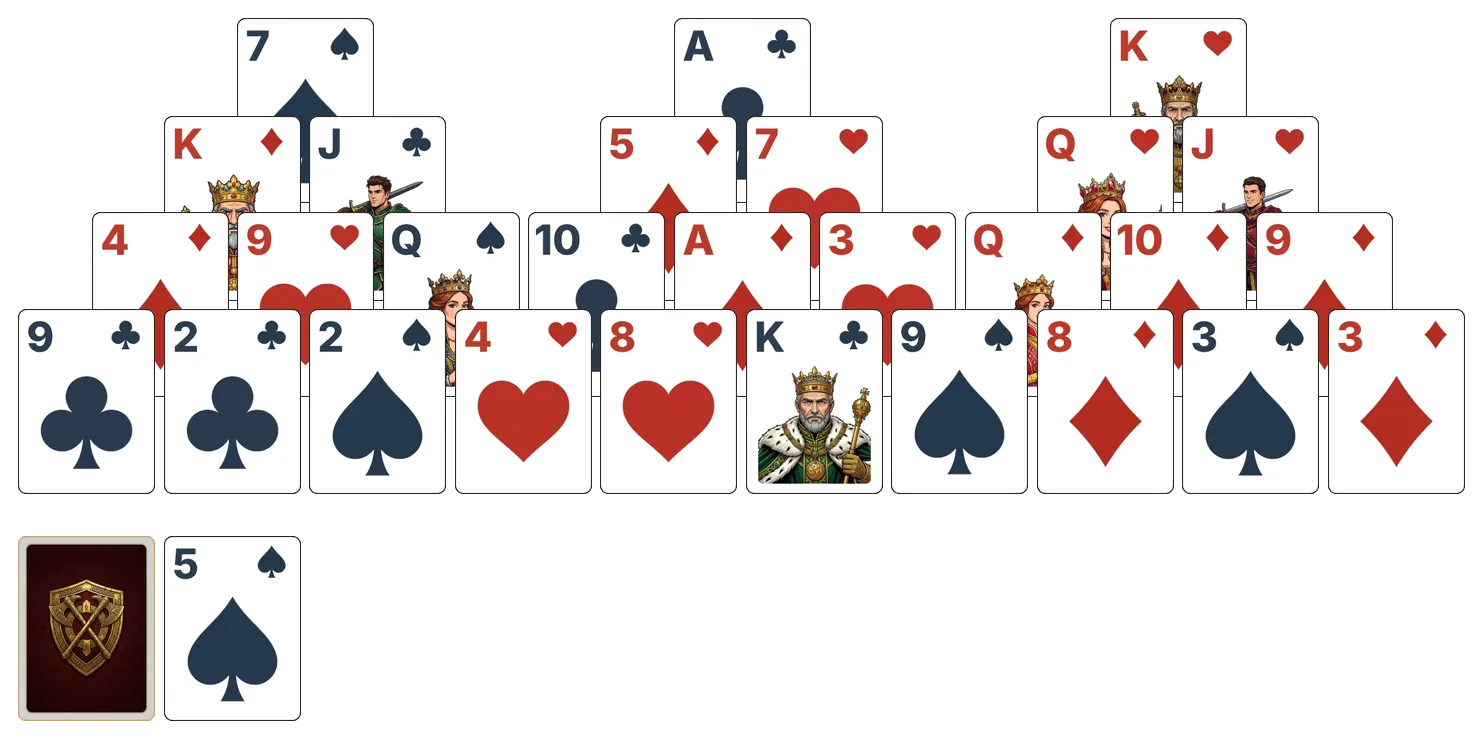
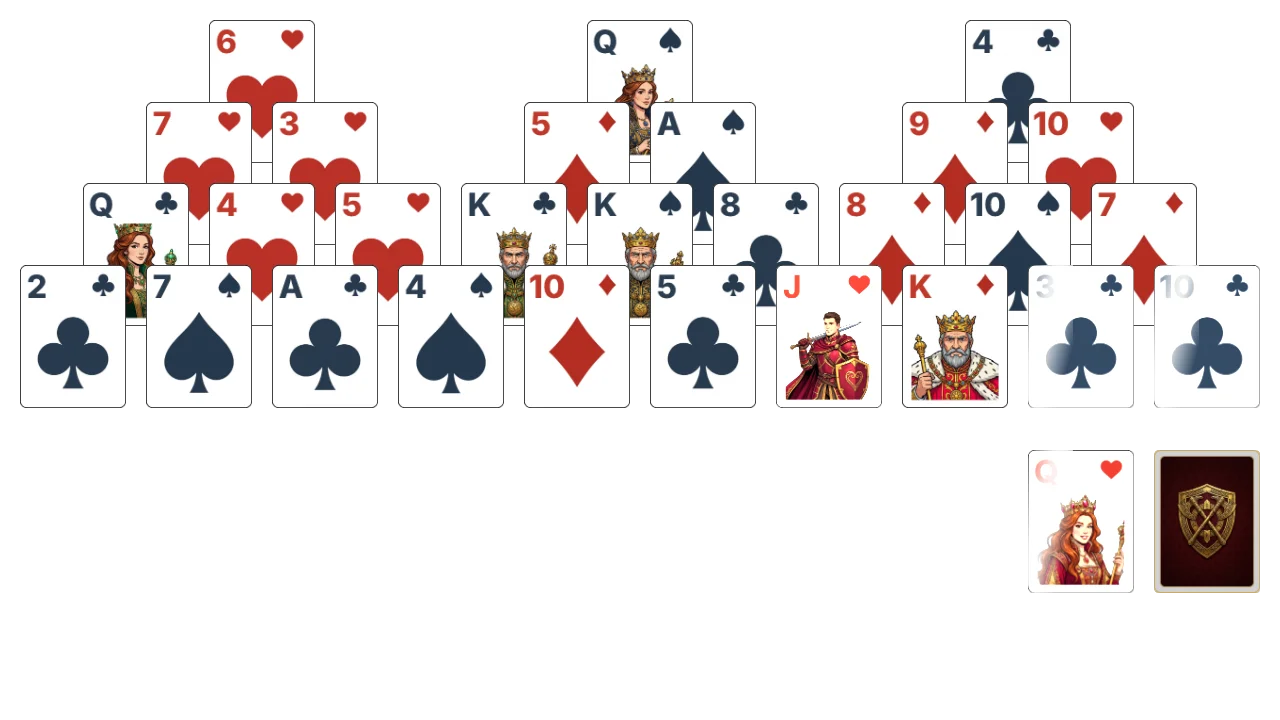
Clear all 28 cards from the three peaks by playing them onto a single waste pile. Each card played to the waste must be exactly one rank above or one rank below the current top of the waste, with suit ignored. The game is won when all three peaks are empty — the cards from the base row don't count for victory, only the three peaks do (in the classic ruleset).
Setup
Shuffle a standard 52-card deck. Deal 28 cards face-down into three overlapping peaks at the top of the layout, each peak shaped as a small pyramid: 1 card at the top, 2 below, 3 below those (6 cards total per peak × 3 peaks = 18 cards), plus a base row of 10 face-up cards beneath the peaks that connect all three. The remaining 24 cards form the stock pile, dealt one card at a time onto a face-up waste pile.
Tri Peaks-Regeln
- Teile 28 Karten auf drei Gipfel à 6 Karten aus, plus eine Basisreihe mit 10 offenen Karten.
- Lege eine beliebige freiliegende Gipfelkarte auf die Ablage, wenn ihr Wert einen höher oder tiefer als die oberste Ablagekarte ist (Farbe egal).
- Asse verbinden sich mit Königen und umgekehrt – die Sequenz ist zirkulär.
- Keine Züge mehr? Decke die nächste Talon-Karte auf die Ablage auf.
- Räume alle drei Gipfel ab, um zu gewinnen.
Win and loss conditions
You win when the three peaks are completely cleared. You lose when the stock is exhausted, no exposed card matches the waste's top rank ±1, and no more moves are possible. Score is calculated from chain length: a chain of N consecutive plays earns 1+2+3+...+N points (so a 10-card chain is worth 55 points vs ten isolated plays at 1 point each = 10). Solitaire Royal's undo button lets you backtrack costly chain breaks; you can also restart the deal or shuffle a new one.
Strategie & Tipps
- Suche die längstmögliche Kette, bevor du den Talon anrührst – jede übersprungene Karte in einer Kette sind verlorene Punkte.
- Bevorzuge Karten, die zwei Kinder auf einmal freilegen, gegenüber Einzelgriffen.
- Begrabe keine wichtige 'Brücken'-Karte unter Karten, die du noch brauchst.
Tri Peaks was designed in 1989 by Robert Hogue at Microsoft (according to Hogue's own accounts) as a successor to Pyramid solitaire, intended to offer faster pacing and higher visual reward. It was first widely distributed in Microsoft Entertainment Pack 4 in 1991 and later included in successive Windows releases. The rolling-rank-by-one mechanic was directly inherited from Golf solitaire (1930s origin), but the three-peak layout and chain-scoring system are Hogue's contributions — and they made Tri Peaks one of the most-played solitaire games of the 1990s and 2000s, second only to Klondike and FreeCell.